


Investment Strategies
To Find Tomorrow’s Winners, Your Investment Process Must Change

This article explores how AI and technology can help family offices identify, access, and invest in future winners.
The following article is from Michael Pomerleau (main picture), partner and co-founder at Investigate VC. The editors of this publication are pleased to use this article and hope it encourages conversations. (To see previous articles from the firm, click here and here.) The customary editorial disclaimers apply. To comment, email tom.burroughes@wealthbriefing.com and amanda.cheesley@clearviewpublishing.com.
Family offices have an obvious advantage when it comes to
investing: capital. But capital alone does not tell you where the
next generation of value will be created, which industries are
approaching structural change, or which companies will ultimately
emerge as the winners.
That requires intelligence.
Our Future Wealth Creation Study found that 83 per cent
of family office CIOs believe that intelligence is becoming more
important than capital when identifying future opportunities.
Family offices clearly recognise the importance of intelligence.
The challenge now is turning that recognition into investment
capability.
How can family offices use AI and technology to systematically
identify where value is moving, expand the opportunities they can
see, and put better intelligence in front of investment
decision-makers? We believe this is where the next evolution of
the investment process needs to happen.
Capital is the starting point, not the investment
system
Family offices already possess many of the ingredients required
for investment success: patient capital, long-term horizons,
entrepreneurial experience, sector expertise, and strong
networks. But those advantages need to work together as a
system.
At Investigate VC, we think about that system as a
progression:
Capital → Intelligence → Access → Human Judgment →
Portfolio → Future Wealth Creation
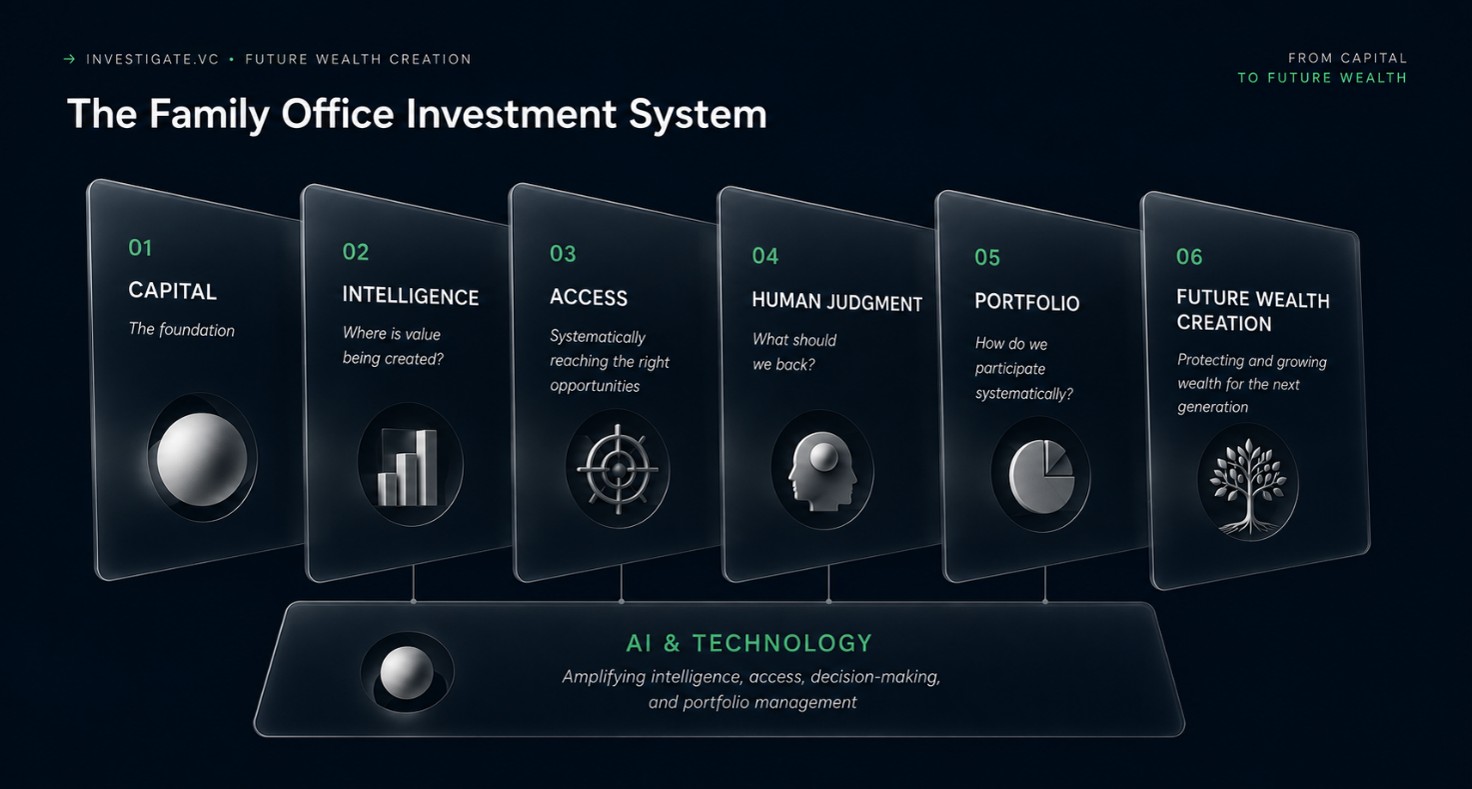
Capital provides the ability to invest. Intelligence helps
determine where value is being created. Access connects investors
with the relevant opportunities. Human judgment determines what
to back, while portfolio construction provides a systematic way
to participate in the potential upside.
AI and technology can strengthen this entire system. They allow
investors to analyse larger information universes, continuously
monitor industries, connect developments across sectors and
geographies, and put better intelligence in front of investment
decision-makers.
This does not replace human judgment. It strengthens the inputs
to it. AI can expand what human investors are able to see,
analyse, and act upon.
This creates an important opportunity for family offices. AI is
not only something to invest in. Increasingly, it is something to
invest with.
To find tomorrow’s winners, start with where value is
moving
Another finding from our study points directly to how the
investment process needs to change. Some 80 per cent of family
office chief investment officers believe industry transformation
will matter more than company selection over the next decade.
Again, family offices recognise the shift. The challenge is
turning that belief into a repeatable investment process.
Company selection remains fundamental. But, before asking which
company to invest in, there is another question worth answering:
Where should we be looking for companies in the first place?
Investment opportunities often enter an investor’s field of
vision through networks, introductions, managers, conferences,
databases, or existing deal flow. The investment process then
starts with the company and asks whether it represents an
attractive opportunity.
Technology allows us to start earlier. Instead of beginning with
“Which of the companies I am seeing should I invest in?” we
can begin with “Where is value being created, and which companies
should I therefore be looking for?”
That changes the sequence:
Industry → Industry Transformation → Value Migration →
Opportunity Spaces → Companies → Investment Decision
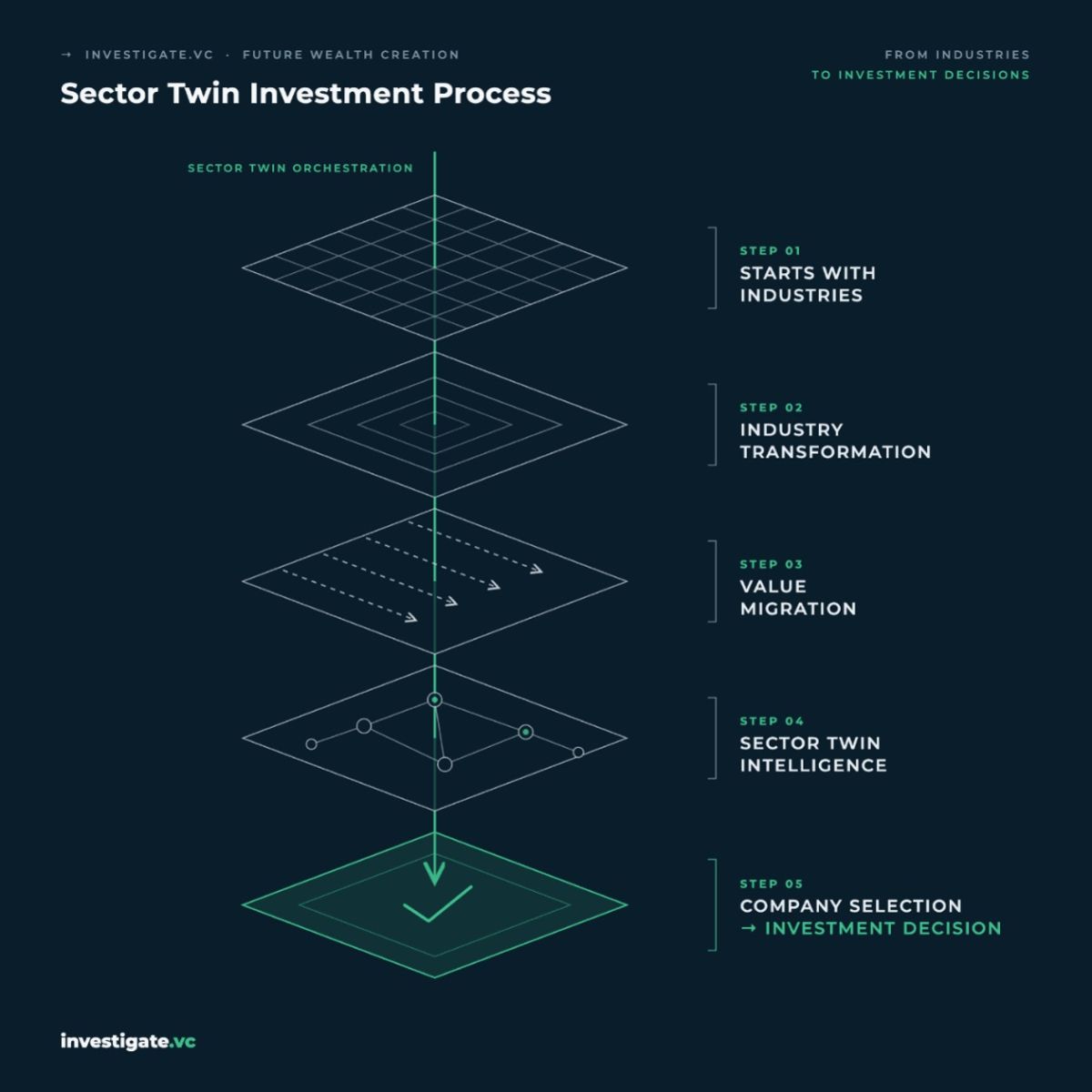
This is what we describe in our Value Migration Framework as the
shift from companies to industries. The company remains the
investment but understanding how an industry is transforming can
give investors a better idea of which companies to search for
before the winners become obvious.
Putting the new investment process Into
practice
At Investigate VC, we wanted to turn this principle into a
practical investment capability. That led us to develop Sector
Twin, our AI-powered approach to investment intelligence.
Sector Twin does not start with a database of companies. It
starts by building a structured representation of an industry:
its physical assets, operational capabilities, economics,
workforce, market dynamics, structural challenges, and unmet
needs.
We then analyse the forces transforming that industry. What is
technology making possible? How are regulation and customer
behaviour changing? Where are economics shifting? Which
bottlenecks could disappear? Where could competitive advantage
move?
The objective is to identify where those changes could cause
value to migrate and translate that movement into specific
opportunity spaces. Only then do we search for startups
positioned to capture those opportunities.
Take logistics as a simple example. Saying “AI will transform
logistics” identifies a trend, but it does not tell an investor
where to invest. We need to understand which parts of logistics
will change, which bottlenecks could disappear, where costs could
fall, what new capabilities could become possible, and where
those changes could create new value.
Once we understand that, the search for companies becomes much
more focused.
AI also allows us to look beyond traditional industry boundaries.
A technology developed for aerospace might solve a problem in
maritime. Computer vision developed for one application could
create value in agriculture. Optimisation technology from one
sector could transform the economics of another.
This matters because the company and the problem it solves do not
necessarily originate in the same industry or geography. AI
allows us to explore these connections at a scale that would be
extremely difficult for an investment team to continuously
analyse manually.
We are not simply using AI to find more companies. We are using
AI to develop a better understanding of which companies we should
be looking for in the first place.
Demand more from your investment process
This shift changes what family offices should expect from venture
investing.
For decades, a strong venture proposition could be built around
relationships: a powerful network, access to founders, and
proprietary deal flow. Those advantages still matter, but in a
world where technology can fundamentally improve how
opportunities are identified and evaluated, access alone is no
longer enough.
If you invest through VC managers, demand more from them. Ask how
they are using AI and technology to identify structural change.
What proprietary intelligence are they creating? How are they
searching beyond the companies and networks they already know?
And how does their investment process help identify opportunities
before they become obvious?
If you invest directly, the same challenge applies. Strong
personal networks and direct access can generate attractive
opportunities, but they do not necessarily provide a systematic
view of what you are not seeing. Combining networks and human
judgment with technology, data, and broader market intelligence
can help reduce the risk of missing tomorrow’s winners.
At Investigate VC, this is the standard we are building towards.
We combine technology and proprietary intelligence with global
sourcing, sector expertise, human judgment, and systematic
portfolio construction. Our investors gain access not only to the
companies we select, but to the investment system behind how we
find them.
This is also part of a broader change in how family offices
operate. As NextGen takes a larger role, they are bringing
different expectations about technology, data, transparency, and
how investment decisions should be supported. The opportunity is
to combine those new capabilities with the capital, experience,
relationships, and long-term perspective that already make family
offices distinctive.
Whether you invest directly or through managers, the challenge is
the same: make sure your investment process is designed to find
tomorrow’s winners not simply the opportunities already within
reach.
About the study
This article draws on findings from The Future Wealth
Creation Study 2026, a global research initiative conducted
by Investigate VC exploring how family office CIOs think about
future wealth creation.
The study was conducted using a panel of 1,000 AI-generated
family office CIO profiles designed to reflect the diversity of
the global family office ecosystem across geographies, investment
styles, sizes and wealth origins.
This approach, often referred to as synthetic research, uses
advanced AI models to simulate how specific groups of
decision-makers might evaluate opportunities, risks and
future scenarios.