


Investment Strategies
Is Your Investment Process Built For Today's Leaders For Tomorrow's Winners?
.jpeg)
Family offices have never had access to more information. Yet many still rely on investment processes developed for a world that no longer exists. AI, new business models and shifting ecosystems change where value is created across almost every industry. A question is whether the investment process itself has kept pace.
The following article comes from Kasper Ulf Nielsen (pictured below), co-founder Investigate.vc (To see a previous article from the author, click here.)
The editors are pleased to share this content for our wealth management audience and we welcome responses and suggestions. The usual editorial disclaimers apply. To comment, email tom.burroughes@wealthbriefing.com and amanda.cheesley@clearviewpublishing.com.

Kasper Ulf Nielsen
Every family office shares the same responsibility: preserving
the wealth created by one generation while ensuring it continues
to grow for the next.
That responsibility has remained constant for decades. The
environment in which it must be fulfilled has not.
Artificial intelligence is reshaping industries. New business
models are emerging at unprecedented speed. Competitive
advantages that once took decades to establish can now be created
or eroded in a matter of years. Entire industries are being
rebuilt as technology, regulation and changing customer behaviour
redefine where economic value is created.
Against this backdrop, we recently completed our Future Wealth
Creation Study, asking a panel of 1,000 family office CIOs a
simple question: Where will future wealth be created?
One finding stood out: More than 80 per cent believed that
understanding industry transformation will become more important
than selecting individual companies over the coming decade. Yet
fewer than one in three expressed high confidence in their
ability to consistently distinguish meaningful structural change
from market noise.
That disconnect should give every family office pause.
It suggests that while investors increasingly recognise the rules
of wealth creation are changing, many are still relying on
investment processes designed for a different era.
In our previous article, we argued that future wealth creation
increasingly depends on understanding change rather than simply
identifying exceptional businesses. We concluded by posing three
questions that every family office should ask:
-- Are we investing in today's winners or tomorrow's value
pools?
-- Where is value moving within the industries we know
best?
-- What is our intelligence advantage?
These questions are closely connected. If you cannot understand
where value is moving, you are unlikely to identify tomorrow's
winners. And if you cannot recognise those shifts before the rest
of the market, your investment process will almost inevitably
arrive after much of the value has already been created.
Which leads to a more fundamental question: Is your investment
process built for today's leaders or tomorrow's winners?
Every investment process has blind spots
Successful investing has never been about finding every
opportunity. It has always been about building a repeatable
process for identifying the right opportunities.
Every investment process therefore reflects a set of assumptions.
It determines where investors look first, which information they
trust most and, ultimately, which opportunities they recognise.
Those assumptions create strengths. They also create blind
spots.
In fact, every investment process is perfectly designed to
identify certain opportunities and perfectly designed to miss
others.
For much of the last 40 years, traditional investment
processes have performed exceptionally well. They begin by
analysing companies, assessing management teams, evaluating
financial performance and understanding competitive positioning.
In markets where industries evolved relatively slowly and
competitive advantages proved durable, this approach consistently
identified outstanding businesses and created significant
long-term wealth.
The challenge is not that this approach has become obsolete. The
challenge is that the environment has changed. Industries now
evolve faster than many investment processes. Artificial
intelligence is reshaping competitive dynamics across sectors.
New technologies spread globally in months rather than years.
Entire categories emerge, mature and consolidate at a pace few
investors have experienced before.
As a result, by the time a company has established itself as an
industry leader, the structural forces that created its success
have often become widely recognised. Analysts understand the
opportunity. Capital has flowed into the sector. Competition has
intensified.
The company may continue to perform exceptionally well. But the
greatest value created by the original structural shift has often
already been captured.
Imagine analysing the automotive industry 20 years ago. The
questions were largely about manufacturing scale, supply chains
and brand strength. Today, those questions remain relevant, but
they no longer explain where the greatest value is being created.
Software, batteries, autonomous systems and artificial
intelligence have fundamentally changed the competitive
landscape.
The challenge is not simply understanding today's leaders. It is
recognising which forces will create tomorrow's ones.
Tomorrow's winners are created long before they are
recognised
Looking back, history has a habit of making great investments
appear inevitable. The reality is rather different.
Consider the financial infrastructure sector. For decades,
competitive advantage centred on issuing cards, acquiring
merchants and processing transactions. Today, the industry is
being rebuilt around entirely different capabilities. Artificial
intelligence, embedded finance, digital identity, programmable
payments and regulatory technology are reshaping where value is
created across the ecosystem.
The businesses likely to define the next generation of financial
infrastructure may not be today's market leaders. They are more
likely to be the companies building the infrastructure for how
money will move over the next decade.
The same pattern is visible across life sciences, industrial
technology, maritime and energy. These industries are not simply
improving. They are being fundamentally restructured by
technologies and business models that barely existed a decade
ago.
This is an important distinction because companies rarely create
these structural shifts.
They benefit from them. The winners capture value. They
do not create it. The implication for investors is
profound.
If tomorrow's winners emerge because industries are changing,
then perhaps the investment process should begin by understanding
those changes not by analysing the companies that happen to exist
today.
That naturally leads to the second question from
our previous
article.
Where is value moving within the industries, we know
best?
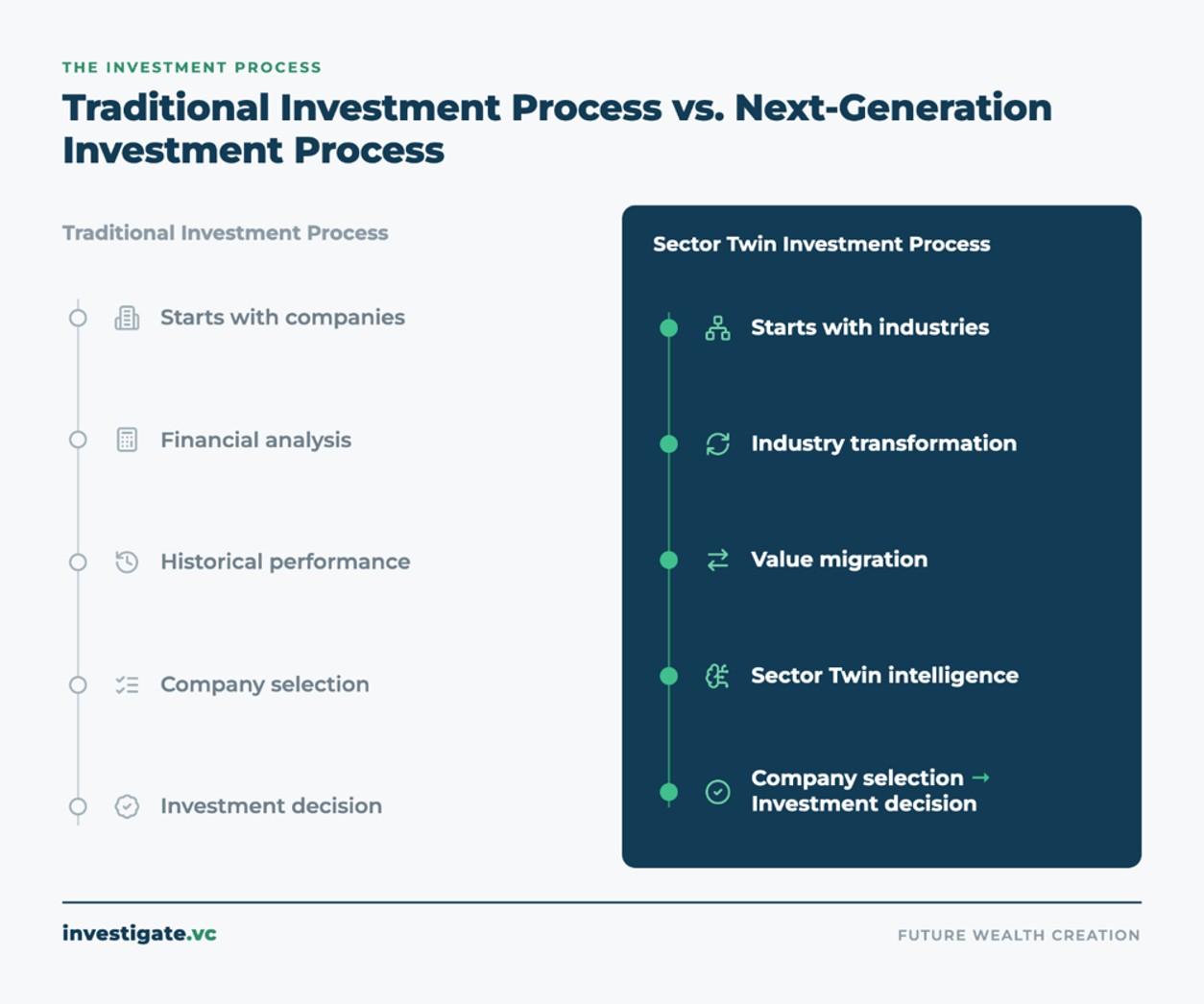
Most investment processes begin with companies. They analyse
revenue growth, profitability, management quality and competitive
positioning. These disciplines remain essential, but they answer
a different question.
They explain why companies are succeeding today.
They tell us far less about where tomorrow's wealth is beginning
to emerge.
Companies do not operate in isolation. They are part of
industries that are constantly evolving, and it is often those
industries and not the companies themselves that determine where
future wealth will be created.
New technologies emerge. Regulation evolves. Customer
expectations change. Capital flows shift. As these forces
interact, value doesn't disappear. It moves.
Some parts of an industry become dramatically more valuable while
others gradually lose their strategic importance. Increasingly,
the force that transforms an industry originates somewhere else
entirely. Artificial intelligence may have emerged from the
technology sector, but it is now reshaping healthcare, financial
services, manufacturing and almost every knowledge-intensive
industry.
It was this observation that led us to develop what we call the
Value Migration Framework.
Rather than beginning with companies, the framework begins with
industries. It asks three questions:
-- Where is value moving? What is driving that movement? Which
new positions of advantage are beginning to emerge?
-- Only after answering those questions do we begin evaluating
individual companies; and
-- Because once you understand how value is moving, identifying
tomorrow's winners becomes a very different exercise.
Building an investment process for tomorrow
As we explored these questions, we reached an important
conclusion: If the way wealth is created is changing, then the
investment process itself must change with it.
For decades, investment research has largely been organised
around companies. Analysts follow management teams, financial
performance and competitive positioning, looking for evidence
that one business will outperform another. That approach remains
essential, but we believe it now represents only part of the
picture.
If industries are increasingly being reshaped by technological
innovation, changing regulation, shifting customer behaviour and
new business models, then investors need a way to understand
those structural changes before they become reflected in company
performance.
That thinking became the foundation of Sector Twin, the
investment process we have developed at Investigate VC.
Sector Twin begins where traditional investment processes often
end. Rather than asking which company is most attractive today,
it starts by building a dynamic understanding of how an industry
is evolving. It continuously analyses the forces reshaping an
ecosystem, identifies where value is migrating and highlights the
new positions of advantage beginning to emerge. Only then do we
ask which founders and companies are best positioned to
benefit.
The sequence matters.
Instead of using industries to provide context for company
analysis, we use industry transformation to guide where company
analysis begins. Artificial intelligence makes this possible, but
AI is not the investment process. It is simply an
accelerator.
It enables us to analyse significantly more information, identify
patterns that would otherwise remain hidden and continuously
update our understanding as industries evolve. The investment
decisions themselves remain grounded in human judgment,
investment experience and the conviction that comes from
understanding structural change rather than simply reacting to
it.
This distinction is important because artificial intelligence, on
its own, is unlikely to create a sustainable investment
advantage. The competitive advantage comes from asking better
questions, interpreting signals more effectively and combining
technology with a clear investment philosophy.
Technology supports the process. It does not replace it.
What family offices really gain access to
If the investment process is becoming the source of competitive
advantage, then the question for family offices changes as well.
Traditionally, selecting a venture capital fund has been about
evaluating access to founders, investment track records and
portfolio construction. Those factors remain important, but they
are no longer the whole story.
Increasingly, family offices are also choosing between different
investment processes. Some continue to begin with companies.
Others begin by understanding how industries are evolving, where
value is moving and which founders are building businesses around
those structural shifts.
That distinction matters because, when a family office invests
alongside a VC fund, it is not simply gaining exposure to a
portfolio of venture-backed companies, its aligning with the
process. And that process should be able to identify the winers
of tomorrow.
For family offices, this changes the role venture capital can
play within a portfolio.
It is no longer simply an allocation to a higher-risk asset
class. It becomes a window into industry transformation. A way of
understanding where value is moving across the economy. A way of
identifying the technologies, founders and ecosystems shaping the
next generation of market leaders.
That perspective has shaped every aspect of how we have built
Investigate VC from our global partner network and research
methodology to the way we source opportunities and construct our
portfolio.
When family offices invest alongside us, they are not simply
accessing a portfolio of venture-backed companies. They are
gaining access to an investment process specifically designed to
identify tomorrow's winners before they become obvious.
The next competitive advantage
This brings us to the third and final question from our previous
article.
What is our intelligence advantage?
The investment industry has spent decades improving the way
companies are analysed. We believe the next decade will be
defined by improving how investment decisions are made.
Information is no longer scarce. Capital is no longer scarce.
Insight is.
The family offices that create the greatest long-term advantage
are unlikely to be those with access to the most information.
They will be those with the strongest ability to interpret
change, separate structural signals from short-term noise and
build conviction before markets reach consensus.
That requires more than better research. It requires a better
investment process. One that begins where future wealth is
created. One that understands how value moves across industries
before it becomes visible in financial results. One that combines
human judgement with new technologies to continuously adapt as
markets evolve.
Every generation of family offices faces defining investment
decisions. Previous generations built extraordinary wealth by
recognising the industries that shaped the 20th
century.
Today's challenge is different. It is not simply adapting the
portfolio. It is adapting the investment process itself. Because
future wealth will not be created by looking harder at
yesterday's winners. It will be created by identifying tomorrow's
winners while they are still being built.
Download the full Future Wealth Creation Study at Investigate VC.
See
here.