


Asset Management
UK Squeeze On Retail Savings Highlights Money Market Funds' Appeal – Aviva Investors

The investment group is one of the players in the field of money market funds – a large market in the US and certain other nations, but less so in the UK. Given recent tax changes and the likely interest rate path, that's an oversight, so Aviva Investors argues.
When the UK finance minister, aka Chancellor of the Exchequer,
Rachel Reeves, squeezed the tax allowances for retail cash
savings accounts last year, it forced some wealth managers to
rethink how cash is put to work.
Such a move puts money market funds – still a relatively nascent
sector in the UK compared with places such as the US – in a
potentially favourable spotlight.
Alastair Sewell (pictured below), senior investment strategist at
Aviva Investors, said Reeves’ tightening of allowances on cash
ISAs may be a teachable moment. Reeves cut the annual cash ISA
allowance from £20,000 ($26,705) to £12,000, starting from April
2027.

Alastair Sewell
“In the UK, money market funds remain underutilised. Bank
deposits often pay rates below the Bank of England base rate and
cash benchmarks,” Sewell told WealthBriefing in a recent
call. “This environment could trigger a broader re-think of money
market funds in the UK.”
According to one definition from BlackRock, a money market fund
is a type of mutual fund, typically holding cash, government
securities or repurchase agreements collateralised by government
securities. Some MMFs can hold government securities, but also
those issued by banks, corporations and non-government bodies. In
the US, another form of fund are those linked to municipalities
that hold municipal securities; earnings are typically exempt
from federal tax. Standard MMFs have a minimum investment horizon
of three months and offer the opportunity of yield uplift.
Aviva sees wealth managers as an important audience for its
funds.
“We continue to engage closely with wealth managers, private
banks and other clients through our regular market insights and
educational materials,” he said.
The UK will have some way to go to get even near the US money
market sphere – the latter hit a total of $8.9 trillion in
December 2025, a record (source: Crane Data). In the UK, such
funds hold about £50 billion. US money market funds have held
stable as a share of overall US mutual fund assets for years –
accounting for 17 per cent of total mutual fund assets, versus
only 3 per cent in the UK.
One reason why the UK has traditionally not had a large MMF
sector is because UK government bonds (gilts) are free of tax, so
they tend to be a tax-efficient alternative for money market
funds.
But change may be coming.
“Money market assets should remain fairly stable through rate
cutting,” Sewell said.
One cause for a positive approach, Sewell said, is that it is
unlikely that the UK will return to the very low interest rates
that took hold after the 2008 financial crash.
The approach
Money market funds typically provide yields materially above the
average bank deposit rates. They target a yield in line with
short-term reference rates such as SONIA (Sterling Overnight
Index Average) – the replacement for the old LIBOR interbank
measure.
“A cash allocation is an important element of most investment
portfolios. While it can be tempting to reduce that allocation in
times of falling rates, it is also important to think about
potential liquidity needs and how they can be met,” Sewell
said.
Generational shift?
One driver and hope for more growth is among younger investors; they have fewer preconceived ideas about what MMFs are and can do, Sewell said. “We might see a broad generational shift in attitudes towards wealth and investing.”
Some concerns
The UK’s Financial Conduct Authority has been reviewing how money
market funds operate, mindful of potential worries about
liquidity strains.
In December 2023, the FCA wrote in an updated consultation
document: “In March 2020, financial markets reacted sharply to
the pandemic and the public health measures introduced to contain
its spread. This shock led to an extreme and sudden ‘dash for
cash’. MMFs came under severe strain as investors withdrew money
from MMFs to meet their often rising needs for cash, and out of
fear of not being able to get their money back from their MMFs
later. This in turn increased the pressure on MMFs, increasing
the risk they would be unable to meet investors’ demands for
their money back. If multiple MMFs used by UK investors had
‘suspended’ there could have been a significant threat to wider
UK financial stability.”
Sewell noted that US dollar-denominated MMFs suffered more stress
during that episode than was the case with other currencies.
He added that the Aviva Investors Sterling Liquidity Fund yielded
4.00 per cent gross as of 22 January 2026 vs SONIA at 3.73 per
cent. According to a chart (see below), the average rate of
interest paid on UK household deposits and the average 1-year
fixed cash ISA rate are both lower than SONIA over multiple
time periods. A fixed cash ISA will not usually allow
withdrawals until scheduled times.
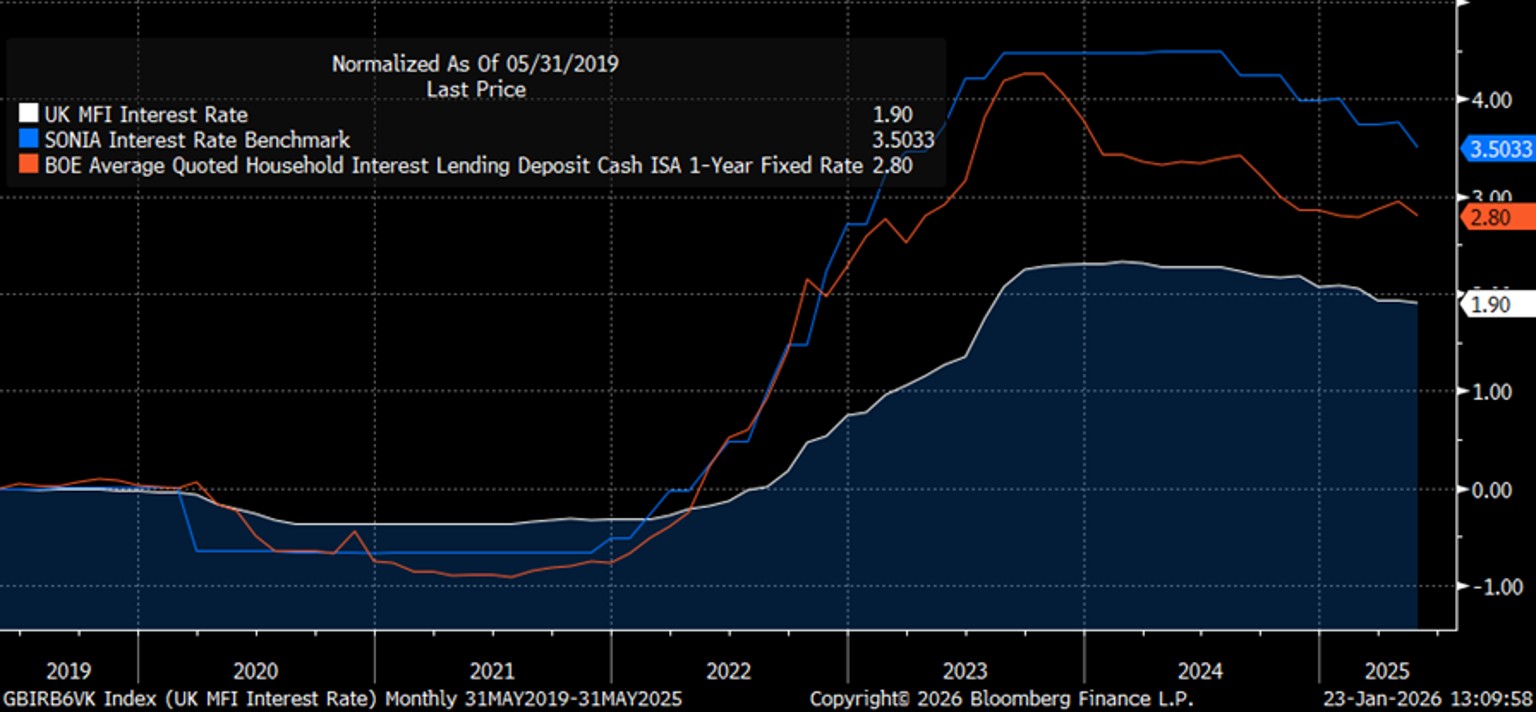
Source: Aviva Investors
(See this interview with Sewell, from two years ago, in which the impact of bank failures and associated volatility had put MMFs in the frame.)