


Client Affairs
UK Cuts Rate; ECB Holds Steady – Wealth Managers React
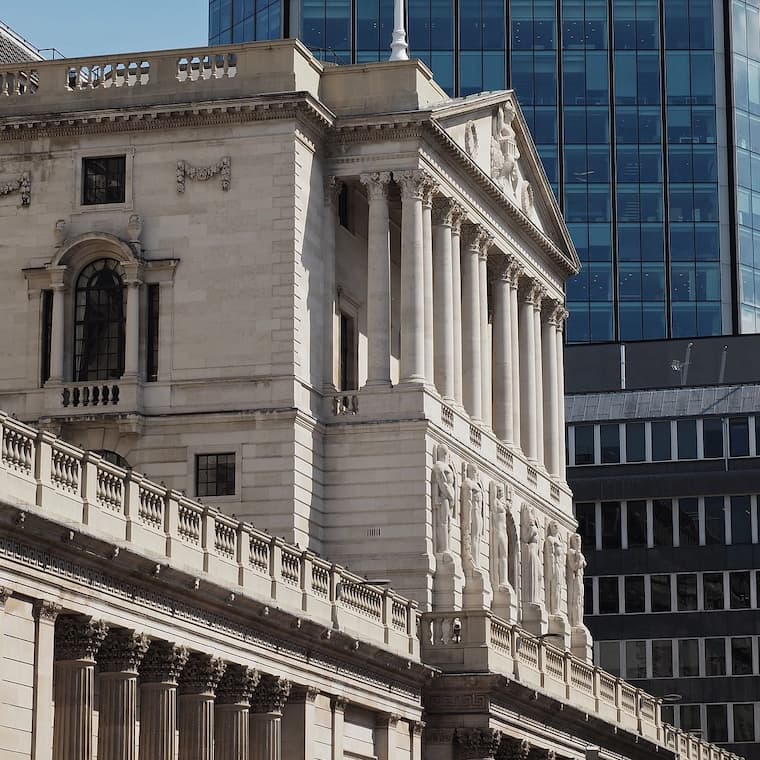
After the Bank of England Monetary Policy Committee voted to cut interest rates and the European Central Bank put theirs on hold, wealth managers discuss the macroeconomic and asset allocation impact, as well as the potential timing of rate cuts.
The Bank of England Monetary Policy Committee (MPC) voted to cut interest rates to 3.75 per cent yesterday, after the UK’s inflation rate fell to an eight-month low. Meanwhile, the European Central Bank (ECB) has kept rates on hold.
The MPC was split five to four in favour of the cut, with the Bank's governor Andrew Bailey casting the deciding vote, marking its fourth and final interest rate cut of 2025. The Bank believes that inflation will fall close to the 2 per cent target sooner than expected. UK consumer price inflation for November fell to 3.2 per cent, down from 3.6 per cent in October.
UK Chancellor of the Exchequer Rachel Reeves said the cut signalled good news for families with mortgages and businesses with loans, but there’s “more to do.”
Meanwhile, the ECB kept rates on hold at 2 per cent on Thursday, as expected, and hiked its growth outlook for the eurozone, predicting growth of up to 1.4 per cent in 2025 and 1.2 per cent in 2026. The EU inflation rate is close to the 2 per cent target at 2.4 per cent and 2.1 per cent in the euro area.
Here are some reactions from wealth managers to the BoE and ECB decisions.
Isaac Stell, investment manager at Wealth
Club
“The better-than-expected inflation numbers gave the BoE
sufficient cover to cut interest rates, with the headline rate
now sitting at 3.75 per cent. However, the MPC was once again
split, with four members voting against cutting rates despite a
clearly declining labour market and weakening economy. For those
voting against the cut, inflationary concerns continue to trump
everything else. With inflation having declined so steeply in
November, traders have ramped up bets for additional rate cuts in
2026, the effect of which helped push the FTSE 100 closer to the
elusive 10,000 mark, a poignant reminder that the stock market is
not the economy.
“Further rate cuts in 2026 should provide consumers with the confidence to splurge rather than save, which will help boost economic growth. The treasury and the government will certainly be looking on in hope of an economic Christmas miracle.”
Daniele Antonucci, chief investment officer at
Quintet Private Bank (parent of Brown Shipley)
“While governor Bailey sees scope for extra easing, given a
slowing economy, he also suggests that this is a closer call.
This came in as a slight surprise, with a more balanced message
than expected given quite a few misses in the economic data
lately.
“The on-hold ECB rate decision isn’t surprising at all. More interesting this time around are the macroeconomic projections. At the same time, it looks as if the eurozone is coping with the US tariffs somewhat better than expected. This is another sign that the outlook for 2026 rests on firmer ground than many feared: the recession that many feared in 2025 never materialised.
“In our strategy, we maintain a moderate preference for equities over bonds. Relative to our long-term allocation, we stay diversified and slightly overweight the UK for its defensive properties. We’re also overweight Europe given spending in defence and infrastructure, and where any hypothetical Russia-Ukraine ceasefire is an upside risk, and attractively-valued emerging markets. We maintain a small US underweight to mitigate the risk that just a few companies drive the market, which nevertheless remains our largest absolute equity exposure.
“Recently, we increased our emerging market equity overweight on attractive valuations, US dollar weakness and stimulus-driven growth in China, which is also a way to diversify the artificial intelligence (AI) theme. Within fixed income, we bought more UK gilts as they could appreciate given BoE rate cuts, while maintaining a reduced dollar exposure and preferring European fixed income relative to the US.”
Andy Jones, portfolio manager on the global equity income
team at Janus Henderson
“After UK inflation was better than expected with consumer price
inflation for November at 3.2 per cent, down from 3.6 per cent in
October, the Bank of England cut interest rates by 0.25 per
cent to 3.75 per cent, as expected. This is the sixth reduction
since the summer of 2024 and, with inflation expected to continue
to fall towards the BoE’s 2 per cent target during 2026, markets
are anticipating at least one further rate cut in 2026.”
Luke Bartholomew, deputy chief economist at Aberdeen
Investments
"Given the run of softer inflation data, a weaker labour market,
and disappointing GDP growth recently, the UK rate cut was widely
expected. But the fact that the vote was so close suggests that
many policymakers are still not convinced that the economy is
fully out of the woods yet when it comes to inflation. However,
with the economy set to remain weak into next year, and various
measures in the recent budget designed to push down on headline
inflation, we think there are more rate cuts to come, with the
bank rate eventually heading back towards 3 per cent late next
year."
Hetal Mehta, chief economist at St James's
Place
"The bar for cutting rates had been incrementally lowered with
the recent raft of data releases painting a gloomy picture of the
UK economy. It’s therefore somewhat surprising to see the vote
split remaining unchanged. Recent data confirm the direction of
travel the bank is likely to pursue, but the magnitude and pace
of cuts in the coming months is still very much up for debate.
The bank now has a delicate balancing act to negotiate. Inflation
is above target and wage growth above 4 per cent meaning that an
aggressive cutting cycle – several back-to-back cuts or even
50 bps cuts – could risk an inflation reversal. On the other
hand, pulling further on the monetary string may well choke off
what little economic growth there is."
Simon Dangoor, deputy CIO of fixed income and head of
fixed income macro strategies at Goldman Sachs Asset
Management
“Weak data could give the BoE scope to cut rates more than
markets currently anticipate next year. The labour market
continues to show signs of deterioration, and we expect inflation
to remain well-behaved through 2026. If evidence continues to
build confirming these trends, the MPC may adopt a more dovish
stance.
“Resilient growth, combined with inflation expected to remain below target, suggests that the ECB will stay on hold for the foreseeable future. While there is some scope for additional easing next year if inflation falls well below 2 per cent, that probability has moved lower. Conversely, the likelihood of a rate hike in 2026 appears very low in our view, given the subdued inflation backdrop – despite recent hawkish rhetoric from committee members.”
Neil Wilson, Saxo UK investor strategist
“Inflation remains too high and, if anything, despite the tax
hikes in the budget, there is a fiscal stimulus (albeit modest)
next year. This makes the outlook for future cuts a little
cloudy, and we know that the MPC has basically cleaved down the
middle into two camps of hawks and doves, with Bailey sitting in
the middle. That means that it only requires one or two members
to shift their view to radically alter the pace and extent of
rate cuts next year. But inflation is coming down just as the
economy is on life-support, so further cuts in February and April
should be expected, with ultimately a 3 per cent bank rate at the
end of this easing cycle."
George Lagarias, chief economist at Forvis
Mazars
“The 0.25 per cent cut was welcome. Even more welcome, would have
been a more unanimous vote. Instead, the five-to-four split
leaves the markets confused as to when the next cut might come.
We still expect the Bank of England to pursue further rate cuts,
as higher unemployment and stifled growth are hardly a breeding
ground for inflation. The bank is, understandably, more
conservative, as inflation remains an unpredictable beast.”
Andrew Zanelli, head of technical engagement at Aberdeen
Adviser
“A UK interest rate cut today was expected and priced in by the
market. Consumers will be divided on whether this is an early
Christmas gift or not. Borrowers will be hoping that mortgage
rates fall as a result and provide some relief to household
finances. On the flip side it’s likely that savings rates will
fall too which will be detrimental to some consumers. They may
need to reassess their financial plans as a result, and this is
when professional financial planners and advisors prove their
worth. By speaking to an advisor, consumers can not just
understand what’s going on but also consider their choices within
a longer-term strategy and make sure their money is working as
hard as it possibly can.”
Hussain Mehdi, macro and investment strategist, HSBC
Asset Management
“UK inflation is heading in the right direction, with the
November CPI data sealing the deal on the rate cut. We believe
that there is space for a couple more cuts in 2026, given the
disinflationary impetus is likely to continue amid lower oil
prices, a weakening labour market, and soft economic growth.
Aspects of the latest budget – such as the fiscal drag from the
extension of tax thresholds, and specific price interventions on
fuel, rail, and energy prices – are also likely to weigh on
inflation in our view.
“After a stellar year for UK equities, further BoE rate cuts could help maintain positive momentum in a market that continues to trade at a record valuation discount relative to other regions. And, given the high starting point for gilt yields, we also see room for gilts to do well in 2026.”
Brad Holland, director of investment strategy at JP
Morgan personal investing
“The cooling across the UK economy over recent months has been a
cause for concern for many in the market. The three-month average
GDP for November was negative across manufacturing, construction,
and services for the first time since late 2023, when the economy
was in recession. Payrolls have also fallen in recent months
while wage growth remains sticky. As a result, policymakers are
having to strike a delicate balance between supporting growth and
taming inflation which is still well above the Bank’s target of 2
per cent. This struggle is not unique to the UK as central banks
across the globe also face this challenge going into 2026.
“For now, it is clear to onlookers that the Bank of England continues to be focused on a ‘gradual’ approach to the rate-cutting cycle. This may disappoint those who hope that faster rate cuts will spur economic growth and reduce borrowing costs, but with uncertainty still high, policymakers remain cautious.”
Guy Gittins, CEO of Foxtons
“The base rate cut is a positive boost for the housing market and
should help maintain the momentum we’ve seen building throughout
2025 as we head towards the new year. Lower borrowing costs will
improve affordability for buyers, while giving additional
confidence to sellers that demand will continue to strengthen
following the removal of Autumn Budget uncertainty. With the end
of the year fast approaching, we expect the market’s steady
performance to continue as motivated buyers and sellers push to
complete before the festive period.”
Richard Merrett, managing director of Alexander
Hall
“This will help to further boost a mortgage sector that has
already seen marked improvements over the last year, irrespective
of the headline rate, with lenders broadening criteria, widening
affordability options, and supporting higher LTV borrowing. The
cut will only strengthen this trend, providing buyers with an
additional boost at a time when confidence is already returning
and the direction of travel remains positive as we head towards
the new year.”
Salman Ahmed, global head of macro and strategic asset
allocation, Fidelity International
"The ECB left interest rates and forward guidance unchanged as
expected, with little shift from its narrative that things are
currently in a good place from its perspective. The ECB is now
pushing a message of growth resilience in the euro area as
forecasts were revised upwards and risks are seen as broadly
balanced, with inflation forecasts close to target, but
undershooting slightly in 2026 and 2027. While rates are likely
to be held in the near term, we see clear risks that
undershooting inflation early next year may prove to be
persistent, prompting action by the ECB due to factors such as a
stronger euro, trade tensions, a dovish US Fed and the effects of
wage disinflation. Moreover, a tightening of financing
conditions, such as through the increase in longer-run yields,
may lead to the ECB considering whether action is needed to
keep the broader financing environment from becoming unduly
restrictive."
Nicolas Forest, CIO at Candriam
“The decision by the ECB to leave policy rates unchanged, keeping
the deposit rate at 2 per cent, confirms rather than redirects
its policy. Firmer growth projections should keep the euro well
supported. Looking ahead, rates are likely to remain on hold
through next year. While new industrial and defence initiatives
should support growth, particularly in Germany, fiscal support
elsewhere is set to remain moderate. Inflation should ease
slightly in Europe as wage growth slows and China exports
continue in a deflationary trajectory. Markets are currently
pricing around a 20 per cent probability of an ECB hike by the
end of 2026, a scenario that appears premature unless we will see
a material upside surprise to growth in the second half of 2026.
By contrast, the US Federal Reserve has re-entered an easing
phase, with policy increasingly shaped by labour-market
developments – a divergence that may become a more prominent
driver of relative rate and currency dynamics.”