Investment Strategies
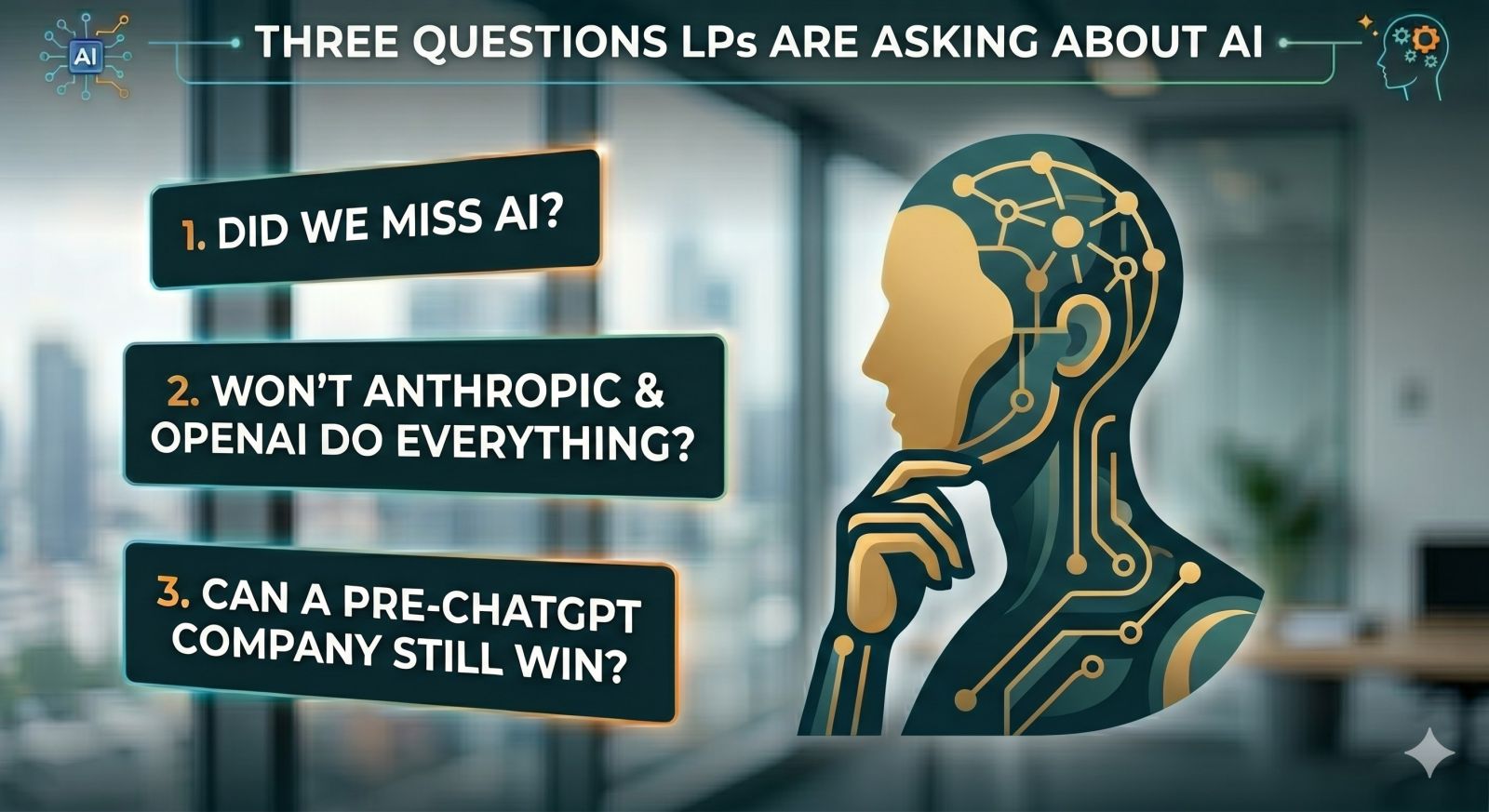
The Three Questions Limited Partners Ask About AI

The author of this article argues that the AI companies that prove to be the most successful won't necessarily be the newest, but those pursuing an enduring need.
The following article comes from Liz Harrow (pictured below), who is a partner at Shakti VC, an inception stage venture capital firm investing in the next generation of AI and space commerce businesses. The editors are pleased to share this content about topics that are, as we have seen with the SpaceX record-breaking IPO and the ascent of major AI breakthroughs such as ChatGPT and its rivals, very much in the public eye.

Liz Harrow
According to the
Organisation for Economic Cooperation and Development in
2025, VC investments in AI firms globally made up more than half
(61 per cent, $258.7 billion of the total), doubling its 2022
share from 30 per cent. “Mega deals” – those valued at more than
$100 – account for 73 per cent of all transactions. VC had
languished in the aftermath of Covid when global interest rates
spiked to curb inflation pressures. The rise of AI as a dominant
tech investment theme was a reason, among others, for a
subsequent rebound in VC fundraising and activity. (See a related
article
here.)
The standard editorial disclaimers apply to views of guest
contributors. To comment and provide ideas, email tom.burroughes@wealthbriefing.com
and amanda.cheesley@clearviewpublishing.com
We are lucky to speak with many smart, thoughtful LPs, and
recently the same three questions have come up
from investors, both family offices and
institutions.
They are good questions, and are likely to be on the minds of
others too. So we wanted to share how we think about them.
1. Did we miss AI?
With all the hype around the first expected LLM IPOs, it is a
fair question. And honestly, some days it can be hard to imagine
what else is left to build.
But we have seen this pattern before, and Amazon’s IPO in 1997 is
a case in point.
When Amazon went public in 1997, many believed that e-commerce
would be a winner-takes-all market. But Amazon was just the first
wave. It helped build the infrastructure and consumer behaviour
that unlocked an entire generation of e-commerce winners,
including eBay in 1998, Overstock in 2002, Blue Nile in 2004, and
later Shopify and Etsy, both in 2015.
Even Jeff Bezos later reflected, “In retrospect, we significantly
underestimated how much time would be available to enter these
categories.”
The good news is that the large LLMs have laid the railroad
tracks. They have built much of the foundational infrastructure
for AI. Now the trains can run, and AI can begin to reimagine
every large industry.
So no, we do not believe that you missed the boat. We are
certainly not closing up shop at SHAKTI. In fact, we believe this
is just the beginning, and we are ready for the next wave of
category leaders.
For more on why we are excited about AI 3.0, check out our post
on the Imagination Era.
2. Won’t Anthropic and OpenAI just do everything?
Also a very good question, especially given how deep the pockets
of these companies are.
My partner Keval Desai has a particularly useful perspective on
this from his time at Google in the years before and after its
IPO. Google tried to enter many categories, and rightfully so.
Some of those efforts included Google Health, Google Answers, a
“knowledge marketplace,” and Google Finance. None of them became
category leaders.
The lesson is that entering a new business line is not as easy as
adding a new product. It often requires different salespeople,
product teams, expertise, and operating models. Eventually, the
experiment may no longer be worth the effort.
Second, customers do not necessarily want everything to come from
the same company. In fact, they often prefer to minimise risk by
working with several suppliers across their technology stack.
That naturally creates room for more vendors.
The takeaway: owning the horizontal infrastructure layer does not
automatically give a company the domain expertise, workflow
empathy, or user trust required to win within a specific
vertical.
Will the big companies try to do everything? Probably. But if
history rhymes, there will still be plenty of opportunity for
application layer companies to build enduring businesses.
3. Can a company founded before ChatGPT still win in AI?
Companies that are not “AI native” can absolutely win in AI. But
we believe they need two ingredients.
The first is an enduring use case. We call this a “toothbrush use
case,” meaning something ubiquitous and frequent. Without the
right use case, the technology itself is irrelevant.
The second is the founder. Is that person able to reimagine the
company using the latest technology in pursuit of that enduring
use case?
Two examples from within our own portfolio illustrate this
well.
Canva, which was founded in 2013, nearly a decade before ChatGPT.
The company was recently ranked fourth among gen AI mobile apps
by monthly active users, according to Andreessen Horowitz. Yet
its mission to “empower the whole world to design” has not
changed.
As Melanie Perkins, our Shakti Titan, has said, “AI has been a
really important part of that for us for many years.”
The second example is Gatik AI, a leader in autonomous trucking
in North America. We first invested in Gatik in 2019, several
years before ChatGPT. Its core use case has remained constant:
moving freight autonomously and at scale. Gatik was founded
before the current AI wave, but it has continued to evolve its
technology stack into a scalable and interpretable AI system that
is purpose-built for safe freight movement. And recently, Gatik
was featured in The Wall Street Journal for its
milestone partnership with Pepsi.
The companies that win will not necessarily be the ones founded
most recently. They will be the ones pursuing an enduring need,
led by founders who continue to reimagine how that need can be
solved.