


Compliance
The New UK Prospectus Regime – What People Need To Know

For those in the private banking and wealth management field who are looking at initial public offerings in London, and the mechanics of the country's listings for companies, there is a new set of rules in force – effective as of 19 January. A major law firm walks explains what's going on.
This publication is pleased to share this content – with permission from international law firm Squire Patton Boggs – on issues stemming from a new business prospectus regime that took effect in the UK a week ago.
The new regime, which is a framework for equity capital
markets transactions, is important for those in the private
banking and wealth management space who need to be aware of the
changes. Policymakers in the UK are trying to make the listings
system in the UK more attractive, to attract capital back to
the London Stock Market, and wider financial sector. Whether
these efforts prove fruitful remains to be seen, but it is
important for the UK’s ability to hold these “liquidity events” –
an important source of new HNW individuals. We hope the article
prompts discussion.
The editors are pleased to share these views; the usual editorial
disclaimers apply to opinions of guest writers and we urge
readers to jump into the conversation. To get involved, email
tom.burroughes@wealthbriefing.com
and amanda.cheesley@clearviewpublishing.com
The UK’s new prospectus regime, which came into force on 19
January 2026, looks at the key takeaways under the new regime for
equity capital markets (ECM) transactions.
Following, the implementation of the new regime, the UK will
no longer follow the previous “dual trigger” regime, which
required a prospectus to be published for (i) the admission of
shares to a regulated market and/or (ii) if an offer to the
public was to be made, with each limb being subject to several
exemptions. Instead, under the new regime, offers of shares to
the public will generally be prohibited subject to exemptions,
which include where the relevant shares are to be admitted to a
regulated market (such as the main market of the London Stock
Exchange (LSE) or a primary multilateral trading facility (MTF)
(such as AIM).
Other off-market exemptions to the general prohibition will
apply including where shares are offered to the public via a
“public offer platform” (POP), ostensibly a crowdfunding
platform, which will be a new Financial Conduct Authority (FCA)
regulated activity. The previous exemptions to the offer to the
public limb under the former regime have also been retained as
exemptions to the general prohibition on public offers under the
new regime, including where the offer is for less than £5 million
($6.83 million) (taking into account other applicable offers
within a 12-month period), which replaces the previous €8 million
($9.48 million) cap, made to fewer than 150 persons in the UK or
made to qualified investors only.
A takeover exemption has also been retained provided the shares
being offered as consideration are not to be admitted to a
regulated market or MTF, and a written statement containing
certain prescribed information accompanies the offer. It will no
longer be possible to carry out a public offer by publishing a
prospectus, the relevant offer will have to fall within an
exemption.
A prospectus will still be required to be published when applying
for admission of shares to a regulated market for the first time
(and depending on its size, on a post-initial public
offering (IPO) admission as well). Similarly, a company’s first
admission to a primary MTF will require the publication of an MTF
admission prospectus (in lieu of the current requirement for an
admission document). From a documentation perspective, market
practice on IPOs will, therefore, largely be unaffected by the
incoming reforms, although, as explained below, practice on
post-IPO pre-emptive issuances could change.
Overview of new prospectus regime’s application to
shares
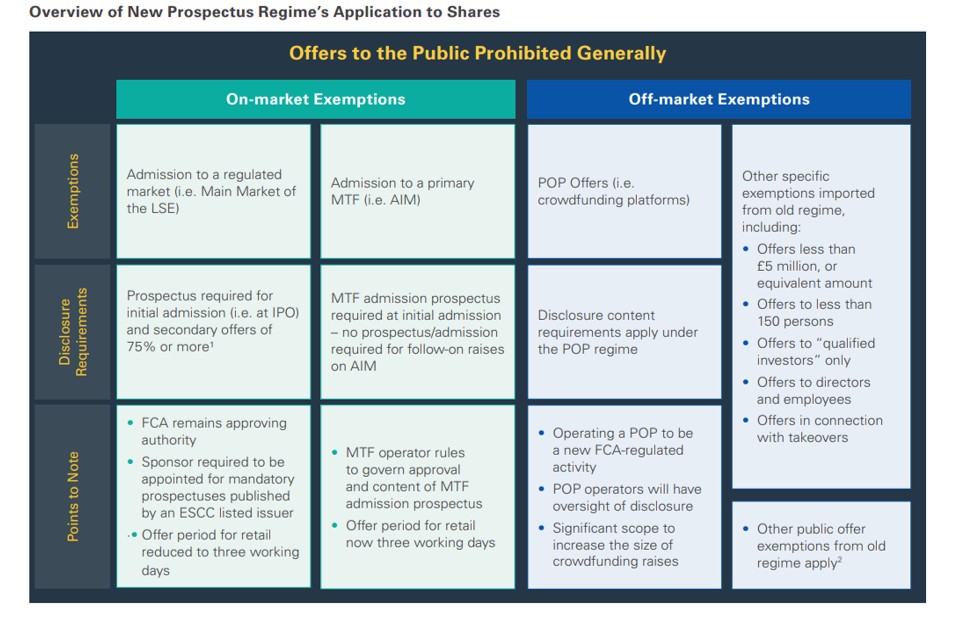
Footnotes to chart
1, The old exemptions from having to publish a prospectus for
an admission of ordinary shares to a regulated market have also
been retained under the new regime – these, in summary, are: (i)
conversion or exchange of other transferable securities; (ii)
shares resulting from conversion or exchange or other securities
under the banking and central counterparty special resolution
regime; (iii) shares issued in substitution for shares of the
same class; (iv) shares issued in connection with a takeover; (v)
shares issued in connection with a merger or division; (vi)
shares allotted to existing or former directors or employees; and
(vii) shares already admitted to a regulated market subject to
certain conditions, principally that they have been admitted for
18 months or more on another regulated market and were
subject to an approved prospectus or equivalent when admitted.
The FCA has issued guidance on the content of prospectus
exemption documents for takeovers, mergers and divisions where
such documents are required to be prepared under the new
Prospectus Rules: Admission to Trading on a regulated Market
sourcebook.
2, Other exemptions to the general prohibition on public offers
include (i) offers to existing shareholders, (ii) offers to
persons already connected with the offeror company and (iii)
securities offered under banking or central counterparty special
resolution regime.
Key ECM takeaways
Further issuances on a regulated market
The biggest change to be implemented under the new regime is the
increase to the threshold that a prospectus is required to be
published for post-IPO issuances of shares within a 12-month
period from 20 per cent to 75 per cent of the number of shares
already admitted to trading to a regulated market. If a
prospectus is required to be published, the issuer may, subject
to certain conditions, elect to publish a “simplified” prospectus
instead.
Issuers will be able to publish a prospectus (which will have to
comply with all prospectus content requirements and be approved
by the FCA) voluntarily at a lower threshold than 75 per
cent. An issuer will be required to appoint a sponsor when a
prospectus is required to be published, but such an appointment
will not be required for the publication of a voluntary
prospectus.
Content requirements for a prospectus
Other than the introduction of specific climate-related
disclosure requirements for issuers who identify climate-related
risks or opportunities in their prospectuses, as well as a small
number of changes to the presentation of information included in
the summaries of prospectuses, the content requirements for
prospectuses under the new regime replicate those under the old.
The FCA has published updated guidance for issuers with complex
financial histories (for instance when they have carried out
acquisitions or disposals during the three-year financial period
covered by the prospectus), which provides additional flexibility
than was the case previously. Working capital statements will
still be required to be included in prospectuses (3) and the FCA
is due to make further consultations on their format in
2026.
Footnote 3, The FCA has indicated that it
will engage further with market participants in 2026 on a
three-tiered approach allowing issuers to make a working capital
statement with either: (i) a clean statement, (ii) a clean
statement with financing judgements or (iii) a qualified
statement. For now, the FCA’s existing guidance on working
capital statements continues to apply AIM.3. The FCA
has indicated that it will engage further with market
participants in 2026 on a three-tiered approach allowing issuers
to make a working capital statement with either: (i) a clean
statement, (ii) a clean statement with financing judgements or
(iii) a qualified statement. For now, the FCA’s existing guidance
on working capital statements continues to
apply AIM.
Protected forward-looking atatements (PFLSs)
Under the new regime, those typically responsible for a
prospectus (i.e. the issuer and its directors) will be able to
benefit from a lower standard of responsibility for certain
forward-looking statements included in the prospectus.
Instead of a negligence-based liability standard, which applies
generally to information included in prospectuses requiring those
responsible for the document to show that the information was
produced on a reasonable basis, PFLSs will be subject to a fraud
or recklessness standard with the burden of proof being on the
investor claiming loss. PFLSs will need to comply with
certain requirements to be subject to the lower standard.
Financial and operational information will be capable of being
covered although a profit estimate for a financial period that
has finished (as opposed to a profit forecast for a period which
has not yet been completed) will not. The new regime will require
PFLS to be presented in a specified manner in the prospectus and
for prescribed disclaimers to be included.
Reduction in the length of retail offer period on
IPOs
Retail offer periods on IPOs will be reduced from three to six
working days under the new regime. The FCA hopes that shortening
such periods will encourage more issuers to carry out retail
offers on IPOs.
MTF admission prospectuses
Applicants to primary MTFs will be required to publish an MTF
admission prospectus. As is currently the case for admission
documents, MTF admission prospectuses will not require FCA
approval; their contents will be governed by the relevant MTF
operator’s (such as the LSE in the case of AIM) rules. Since an
admission of securities to a primary MTF is an exemption to the
general prohibition on public offers under the new regime, MTF
admission prospectuses can be used for retail offers that exceed
the revised £5 million cap mentioned above. MTF operators will
have the discretion to decide when an MTF admission
prospectus is required for post-IPO share issuances. AIM
has confirmed that no MTF prospectus or admission
document will need to be published by AIM companies on
post-IPO fundraises (as is currently the case).
The current exemptions from having to publish an admission
document available under the AIM designated market and Aquis
Stock Exchange (AQSE) fast track routes have been retained, as
has the requirement for one to be published following a reverse
takeover. The statutory responsibility, advertisements,
supplementary prospectus, withdrawal rights and PFLSs
requirements applicable to regulated market prospectus will
also apply to MTF admission prospectuses.
Our thoughts
Main market
Issuers will be able to carry out larger secondary offers without
needing to publish a prospectus, but it remains to be seen
to what extent market practice will gravitate towards the maximum
75 per cent threshold or settle for publishing voluntary
prospectuses or, potentially, some other form of offering
document (not approved by the FCA) at a lower limit (albeit a
higher one than 20 per cent). UK fundraises involving US
shareholders will, in all likelihood, see the publication of
voluntary prospectuses or offering documents at lower
thresholds.
Absent of preparing a voluntary prospectus or offering document,
issuers will be carrying out larger equity raises using their
ordinary course public disclosure (annual reports, interim
reports and trading updates) than they have in the past. Above
all though, the new regime should
facilitate including existing retail shareholders in
secondary fundraisings carried out by listed companies as well as
retail investors more generally on IPOs. Similarly, the new
regime will make retail investor participation on secondary
selldowns (for instance a post-IPO block trade) easier, although
the requirements of the UK financial promotion regime will need
to be followed.
Listed companies will still need to adhere to the limits
contained in their shareholder approvals in relation to the
issuance of new shares and the disapplication of pre-emption
rights.
If issuers are to make use of the higher threshold for when a
prospectus needs to be published then, in the majority of cases,
some form of pre-emptive offer structure (open offer or rights
issue) will need to be used by them in light of 10 per cent +10
per cent limit on disapplication authorities included in the
Pre-emption Group (PEG) Guidelines on the Disapplication of
Pre-emption Rights (the PEG Guidelines) which listed companies
are expected to follow. Companies that need to raise larger
amounts of capital more frequently (so-called “capital hungry
companies” under the PEG Guidelines) will be able to seek larger
disapplication authorities from their shareholders provided that
the reasoning for exceeding the above limits is specifically
highlighted at the time that the request for a general
disapplication is made. IPO candidates should disclose in their
IPO prospectus if they intend to be a “capital hungry
company.”
Implementing the admission of securities to a primary MTF
exemption to the general prohibition on public offers under the
new regime will facilitate the inclusion of larger retail offers
on AIM fundraises. Historically, retail components on AIM
fundraises (including pre-emptive ones) have had to be subject to
the GBP equivalent of the previous €8 million cap (even when
carried out pre-emptively, for example, in the case of
an open offer), in order not to trigger the requirement
of publishing a prospectus.
This will no longer be the case meaning that larger retail
components could be carried out by AIM companies (both at IPO and
subsequently) albeit in compliance with the relevant company’s
allotment and disapplication of pre-emption right authorities
(passed either at the company’s last annual general meeting or
obtained specifically for the transaction at a general meeting).
It is also worth noting that that the changes being brought in by the FCA to the Market Conduct Handbook will allow issuers with securities already admitted to AIM to admit further classes of securities, whether they are fungible with those already admitted to trading, without having to publish a separate MTF admission prospectus. It will be interesting to see to what extent market practice develops to make use of this flexibility.
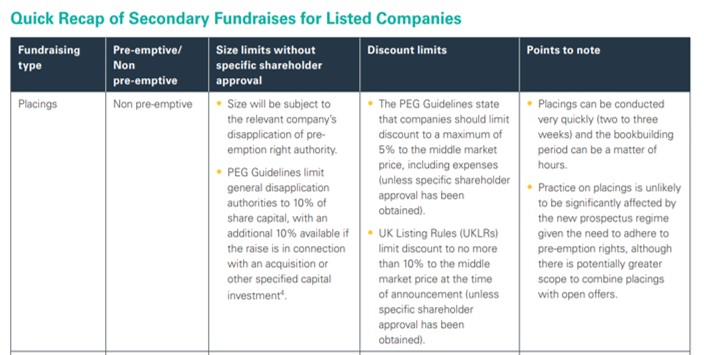
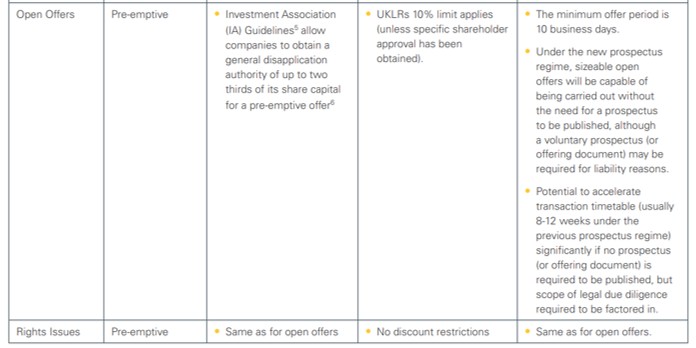
Footnotes to chart
4, The PEG Guidelines relate to issuances by companies listed
in the Equity Shares Commercial Companies Category. AIM companies
are also encouraged to adopt them. The PEG Guidelines also permit
small additional increases of up to 2 per cent to these
limits for concurrent retail raises.
5, The Investment Association Share Capital Management Guidelines
(IA Guidelines).
6, N.B. IA Guidelines preference for rights issue for larger
fundraises.