


Investment Strategies
The Magnificent Seven Growth Paradox: Record Earnings Meet CapEx Jitters

Whatever volatility there is in equities – perhaps an inevitable sign of a sector in ferment – AI remains a fundamental economic pillar for the next decade, the author argues.
The following article, which addresses the state of equity
markets and issues such as concentration risk, is from Khaled
Louhichi (pictured below the article), head of research at
Mirabaud
Wealth Management. The editors are pleased to share these
insights; the customary editorial disclaimers apply to views of
guest writers. Email tom.burroughes@wealthbriefing.com
and amanda.cheesley@clearviewpublishing.com
The latest earnings season for the “Mag7” (excluding Tesla and
Nvidia) presents a paradox: fundamentals are robust, yet market
reactions are increasingly sceptical. While the group delivered
impressive earnings per share (EPS) growth in the last quarter of
2025, ranging from 11 per cent to 31 per cent, stock price
reactions were largely flat or negative, with one notable
exception.
A clear theme has emerged; investors are no longer satisfied with
“AI promise.” They are demanding immediate returns on the massive
capital expenditures (CapEx) being deployed. The “AI Arms Race”
has transitioned into a "Show Me the Money" phase, where the cost
of growth is under the microscope.
The CapEx conundrum: growth is not enough
For Microsoft and Alphabet, the message from the market was
brutal but clear. Despite posting stellar earnings per share
growth of 28 per cent and 31 per cent respectively, both saw
their stock prices struggle immediately post-release, Microsoft
dropping 10 per cent and Alphabet ending more or less flat.
The culprit? Fears of spiralling AI-related CapEx. As these
hyper-scalers continue to pour billions into GPU clusters and
data centres to secure their AI future, investors are growing
wary of the depreciation drag and the timeline for return on
invested capital (ROIC).
The robust top-line and bottom-line growth were overshadowed by
the sheer scale of investment required to maintain their
leadership, leading the market to discount the immediate value of
their earnings beats. The “AI tax” on valuation is real: massive
growth is being treated as “table stakes” rather than a catalyst
for multiple expansion.
Meta platforms: the efficiency outlier
Meta platforms stood alone as the clear winner of the season,
surging over 10 per cent following its release. Interestingly,
Meta’s EPS growth of 11 per cent was lower than its peers, yet
the market rewarded it.
This divergence underscores a critical lesson: the market favours
visibility and efficiency. Meta has successfully communicated a
narrative whereby AI investment is directly fuelling core
business performance, specifically in advertising efficiency and
user engagement, rather than just future theoreticals. By
balancing its aggressive AI spend with continued discipline (the
enduring legacy of its "Year of Efficiency"), Meta managed to
convince investors that its CapEx is not a black hole, but a
lever for immediate monetisation.
Apple: the resilient ecosystem
Apple delivered a "steady as she goes" performance, with 18 per
cent EPS growth and a flat-to-positive stock reaction (+0.5 per
cent). Unlike the hyper-scalers caught in the CapEx crossfire,
Apple’s narrative remains tethered to the resilience of its
consumer ecosystem and high-margin services
revenue.
While less directly exposed to the server-side AI buildout fears,
Apple benefits from a perception of safety. Its “Apple
Intelligence” strategy is viewed as an ecosystem lock-in feature
rather than a capital-intensive infrastructure bet, insulating it
from the CapEx jitters that plagued Microsoft and Google. The
double-digit EPS growth reaffirms the durability of its premium
franchise even as the broader tech sector grapples with
investment cycles.
Diverging fortunes in 2026
The table below summarises the stark disconnect between
fundamental performance and market reaction this quarter:
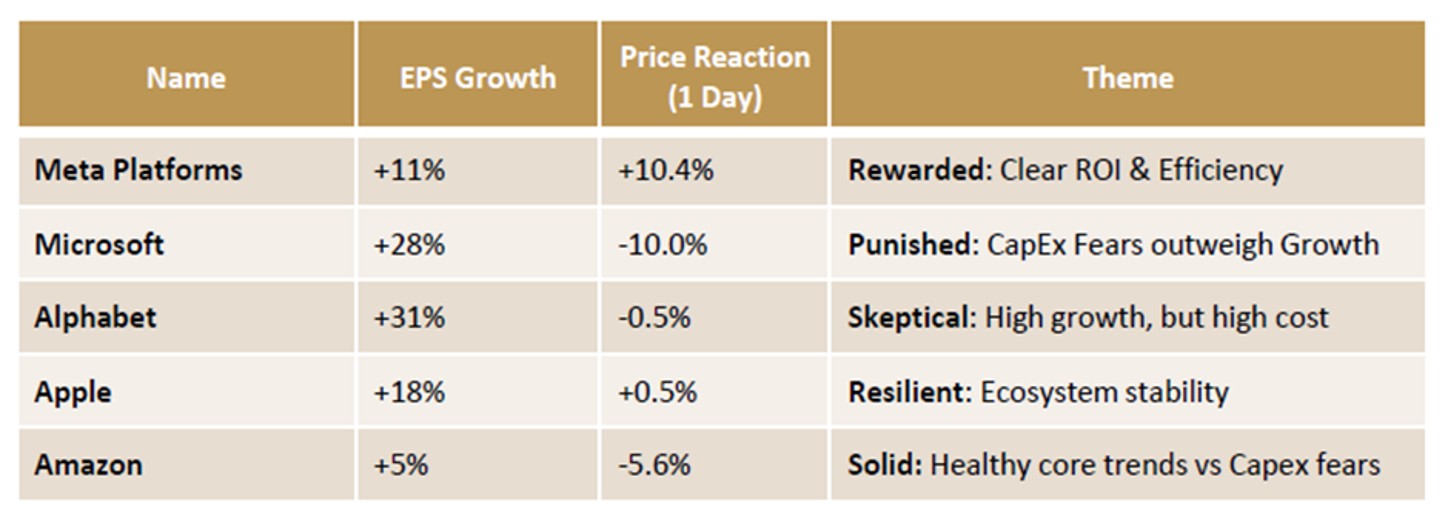
Looking ahead: the "proof" phase
As we move deeper into 2026, the burden of proof has shifted. The
initial euphoria of the AI boom is over, and the infrastructure
buildout phase is now being scrutinised for capital efficiency.
For the Mag7, the next leg of stock performance will likely
depend not just on growing AI capabilities, but on demonstrating
that these massive investments can generate cash flow margins
that justify the spend.
The divergence between Meta and Microsoft this quarter suggests
that investors will mercilessly punish "spending without
immediate visibility" while rewarding those who can show that the
AI cheque is already in the mail.
However, this short-term volatility does not signal structural
weakness. AI remains a fundamental economic pillar for the next
decade. The investment thesis is widening beyond tech giants to
physical constraints such as energy and grid infrastructure,
making continued exposure, and the patience to weather
volatility, a strategic necessity.

Khaled Louhichi