


Alt Investments
The Evidence Is In: Private Markets Beat Listed Equities

Data shows, the firm says, that private market investing, while less liquid, comes with superior yield and outpaced the results of listed equities. There appears as yet no end in sight to enthusiasm for sectors such as venture capital, private equity and credit.
Nearly $2 trillion of private assets, which were held by
high net worth investors in 2021, have outperformed returns of
listed equities, a situation likely to be compelling for people
fretting about market gyrations and high inflation, a survey
shows.
New York-listed investment firm Hamilton Lane, with
$851 billion in assets under management and supervision, said in
a report that private equity generated an extra 83 cents per
dollar invested since 2017. Private real estate and credit, with
significantly lower risk profiles than equity strategies, have
also done “remarkably well,” the firm said.
There has been a steady drum-beat of commentary on and advocacy
for private market investing over recent years. More than a
decade of ultra-low official interest rates – now slowly starting
to change – has crushed yields on conventional equities and
government bonds. This has encouraged an influx to areas such as
private equity, venture capital and forms of real estate.
Investors have had to tolerate the lower liquidity of these
investments in exchange for superior returns. A cluster of firms,
such as CAIS and
iCapital, among
others, have also developed platforms to make it easier for
investors to tap into previously hard-to-enter sectors.
“The global financial markets continue along a trend of rapid
change that we’ve experienced during the last two years of the
pandemic,” Mario Giannini, CEO of Hamilton Lane, said.
Hamilton Lane’s report draws from its database covering more than
$15 trillion of assets and 45,000 funds.
“We’re examining what’s driven outperformance of late, what
factors are disrupting and transforming the private markets, as
well as what the investor experience could be going forward –
particularly as the asset class continues to expand its investor
base into the private wealth market,” Giannini said.
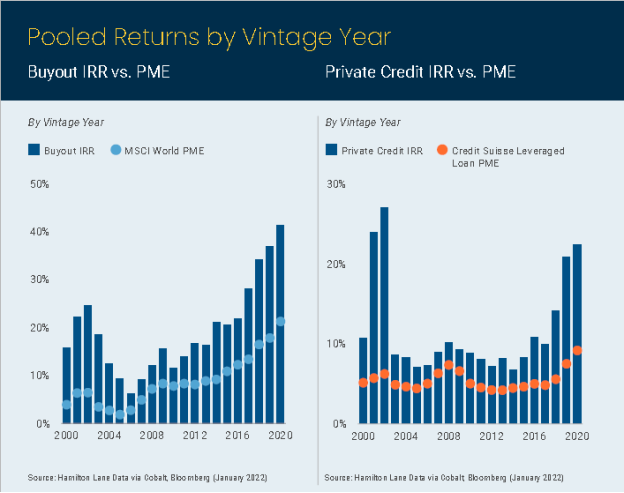
In a longer-term picture of private equity’s performance vis a
vis public markets, the chart below shows pooled average buyout
returns, which have outperformed in every single one of the past
20 vintage years and by an average of more than 1,000 basis
points. Private credit also outperformed in every vintage year
over the last 20. These charts show vintage years and public
market equivalent (PME) – a measurement accepted by investors as
the most appropriate way to benchmark returns, Hamilton Lane
said. (Internal rates of return account for the complex timings
of private equity deals and are not strictly comparable
with those of listed equities, but the PME measure is a
rough equivalent.)
Performance of private markets vs public
markets
The firm also tracked the opportunities available for private
investing. Fundraising has hit a record, on track for a 25 per
cent jump from 2020 to 2021.
The firm said that it had identified a trend for 2022 dubbed the
“15/15 club” – an estimation that at least 15 buyout managers are
seeking to raise $15 billion or more in the coming year. Taking
into account the fact that the managers may outpace their stated
targets and the previous fund sizes of these managers, this
number could top roughly $300 billion – 50 per cent above the
level in 2020.
Access to private markets is widening. The number of smaller
institutional and HNW investors taking part in private markets
increased again in 2021.