


Alt Investments
The "Direct Co-Investment" Route To Superior Private Market Returns – Morgan Stanley Study

There has been a large shift over the past two decades from listed public companies to privately held ones. A typical way to access this opportunity is via private equity funds. The route of "direct co-investment" deserves more attention, says Morgan Stanley.
Direct co-investment offers a way to tap into the world of
private markets without incurring some of the costs of using a
“co-mingled” fund. And, if handled correctly, investors can still
spread risks in a way that they could not achieve by doing
everything themselves, argues Morgan
Stanley Wealth Management in a recent paper.
“Today, private markets are responsible for a substantially
higher portion of innovation and value creation than in prior
years, which makes them very attractive for investors pursuing
alpha. As private market portfolios mature and return enhancement
continues to be a primary investment objective, investors may
seek to augment their exposure by accessing direct co-investments
in targeted sectors and strategies alongside favored fund
managers at more attractive fees,” the US bank said in the
report. The paper is entitled A Tug Of War: Public Versus
Private.
“Since individual direct co-investments may be deemed high risk,
investors are well advised to deploy a portfolio approach
tailored to their own needs. In this manner, investors will be
better equipped to balance the potential for upside return
against sizable downside risk while seeking to benefit from
significant potential diversification flexibility,” it said.
However, azfter fund vehicles have dominated private equity and
venture capital, the focus is switching toward direct
investing, Morgan Stanley said. For most investors, this means
that they can cut fees paid to fund managers, reduce the risk of
putting money into a “blind pool” and carry out their own due
diligence on investments. This also moves away from the
“co-mingled” funds model that has been the norm in recent years.
According to one online definition, direct co-investing is "when
an investor invests alongside a sponsor in a direct investment
and the investment is not part of a greater GP-LP blind pool fund
relationship with the sponsor."
Morgan Stanley said co-investments benefit from a variety of
forces: Private equity fund managers that want to make bigger
deals are constrained by portfolio construction guidelines that
cap the amount of equity per deal. Managers may have discretion
to allocate a portion of excess capacity to other prospective
limited partners. High net worth investors are still a relatively
untapped market for private equity funds.
Investors can gain exposure to direct co-investments either
through a co-investment fund, which are typically diversified
portfolios of co-investments within a 10-year fund structure, or
investment in individual co-investment deals. As a rule,
individual direct co-investments are structured as or through
special purpose vehicles (SPVs), with the SPV investing alongside
a lead sponsor’s fund vehicle, Morgan Stanley said.
Secular shift
There is a secular shift in favor of private markets as firms
take longer to float on stock markets or even decline the listed
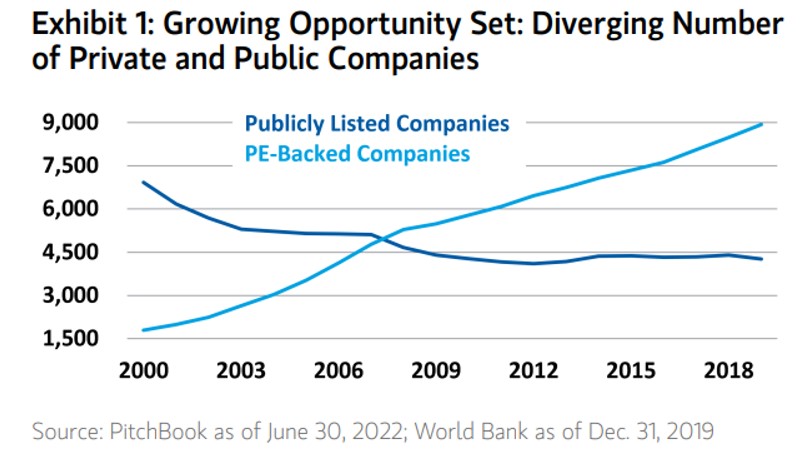
route at all. In its nine-page paper, Morgan Stanley noted that
between 2000 and 2019, the number of publicly traded US companies
collapsed by almost 40 per cent to 4,200. Conversely, the number
of private US companies backed by private equity firms surged by
almost 500 per cent, from 1,800 to 8,900.
Also, there are fewer than 3,000 public companies with annual
revenue greater than $100 million, while there are more than
14,000 private businesses with comparable revenue
levels.
There are various reasons for the shift. It is getting easier for
private equity and venture capital to attract funds. And it
continues: PricewaterhouseCoopers predicts that private markets’
AuM will rise to almost $15 trillion by 2025, versus $4.9
trillion in 2021. Another driver is the Sarbanes-Oxley Act,
introduced in the early Noughties after the Enron accounting
scandal that significantly added to regulatory burdens on listed
firms. A third headwind for public firms is the chore of handling
quarterly results and having to deal with skittish investors.