


Investment Strategies
Private Credit For Private Wealth Portfolios

The author argues that in an environment of shifting inflation dynamics, true diversification increasingly depends on assets grounded in measurable cashflows rather than market cycles.
The following article is from Francesca Filia (pictured below), who is chief executive and founder of Fasanara Capital, a company this publication has interviewed before. He examines a number of issues in today’s fixed income markets and where private credit sits in the portfolios of private clients. The editors are pleased to share these views; the usual editorial disclaimers apply to views of guest contributors. To comment, please email tom.burroughes@wealthbriefing.com and amanda.cheesley@clearviewpublishing.com

Francesca Filia
Inflation patterns are diverging across Southern Europe. This is
leading fixed income investors to refocus on stability,
liquidity, and diversification with asset-based finance and its
exposure to the real economy emerging as a complementary
component in their portfolios.
Italy provides an instructive case. For decades, Italian private
banking portfolios were built on a simple foundation: government
bonds that offered safety, yield, and predictability – the
pillars of post-war wealth management. That foundation, however,
is evolving. As Europe transitions into a new equilibrium after
years of volatility, the macroeconomic backdrop – and with
it, investors’ priorities – is shifting.
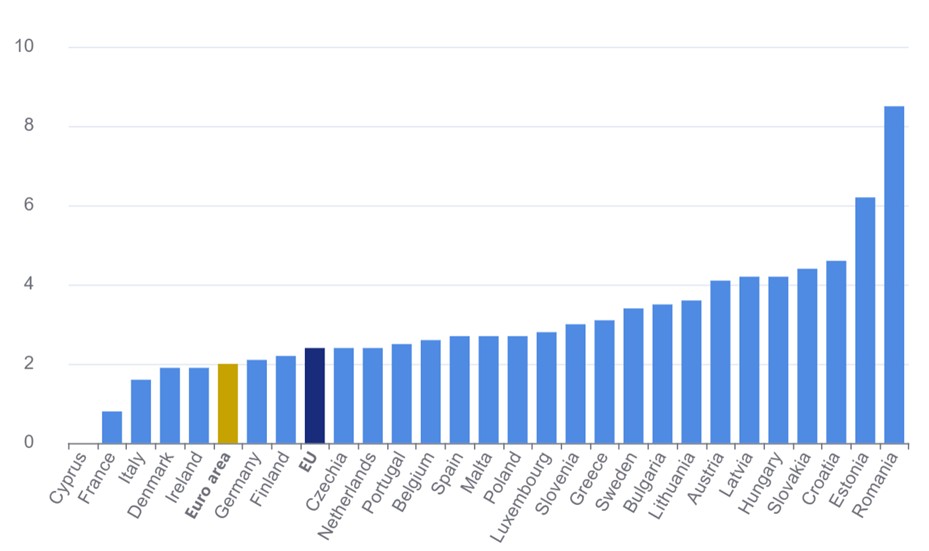
One key area of divergence is inflation. In Italy, inflation has
moderated to around 1.6 per cent as of August 2025 (Figure 1).
Falling import prices, moderate wage growth, and a firmer euro
have restored price stability. Energy, once inflationary, is now
broadly disinflationary.
However, in Spain, the picture is more complex: headline HICP is
expected to remain at around 2.3 per cent, while core inflation
recently rose to 2.7 per cent – its highest level in 10 months. A
tight labour market and rising housing costs have made Spain one
of the eurozone’s more inflationary economies.
This disjunction is increasingly shaping portfolio design across
Southern Europe. With inflation normalising in Italy but
lingering in Spain, investors are refocusing on real yield,
diversification, and liquidity – priorities that extend
beyond traditional fixed income.
Figure 1: Annual inflation rates (%) across Europe in August 2025
Source: eurostat
From bonds to broader diversification
Italian private banking portfolios still reflect their heritage:
large allocations to sovereign and bank bonds, complemented by
equities and cash. Yet as yields fluctuate and spreads narrow,
investors are broadening their horizons. Typical allocations now
combine:
-- Fixed income: shorter duration, stronger credit
focus;
-- Equities: more global and thematic, from AI to
semiconductors and defence;
-- Private markets: including private equity, private debt,
and infrastructure; and
-- Cash: retained for flexibility, but less central to
long-term returns.
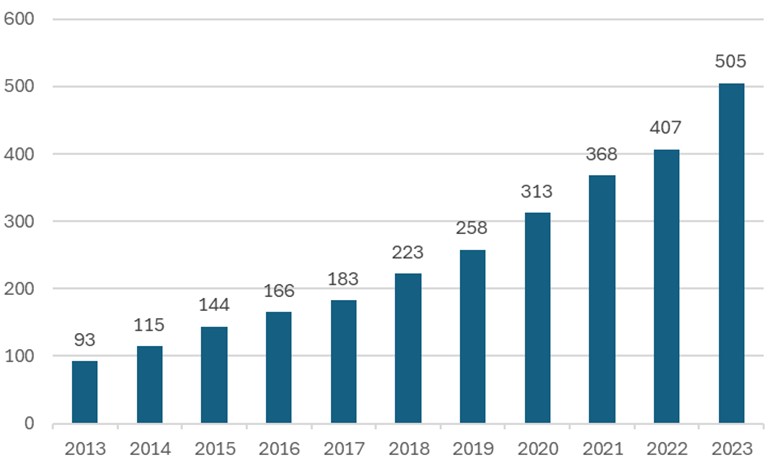
Across both Italy and Spain, one trend stands out – rising
interest in private credit (Figure 2), particularly strategies
offering real-economy exposure with short durations and limited
lock-ups.
Figure 2: European private credit AuM, 2013-2023 (US$ billion)
Source: Preqin
Understanding private credit’s resilience
Private credit’s defining feature is its cashflow-based
valuation. Unlike private equity – where returns depend on
multiple expansion or exit markets – private credit derives
value from contractual repayments. Portfolios that hold
short-term receivables backed by large corporate obligors, with a
focus on repayment performance, can help mitigate key risks
by:
-- Aiming to moderate mark-to-market volatility; though
valuations can still fluctuate;
-- Lower sensitivity to public-market valuation multiples;
macro conditions can still affect borrower performance and
collateral values;
-- Reduced dependence on external refinancing/IPO markets;
and
-- Regular amortisation as receivables repay and proceeds
are typically recycled; timing and liquidity are not assured.
In private credit, returns compound through repayment rather than
re-rating – a feature that underpins resilience during
periods of market stress. For private wealth investors, this
could potentially make private credit a natural counterweight to
private equity: less cyclical, less correlated, and more
predictable.
Integrating private credit alongside real estate, bonds,
and equities
When viewed alongside traditional portfolio pillars, private
credit serves a distinct function – complementing real estate,
equities, and fixed income rather than competing with them
(Figure 3).
Figure 3: Private credit characteristics relative to major asset
classes

Source: Fasanara Capital
As portfolios evolve beyond the traditional triad of equities,
bonds, and real assets, private credit is increasingly seen as a
fourth pillar – grounded in contractual cashflows rather
than market valuations.
ELTIF: the bridge to private credit
democratisation
The introduction of the European Long-Term Investment Fund or
ELTIF marked a key milestone for Europe’s private-markets
landscape. The revised framework streamlines eligibility rules,
broadens investor access, and increases flexibility in portfolio
composition. Under this regime, private-credit strategies
–including short-duration, asset-backed lending vehicles
– can be offered through regulated structures for qualified
investors.
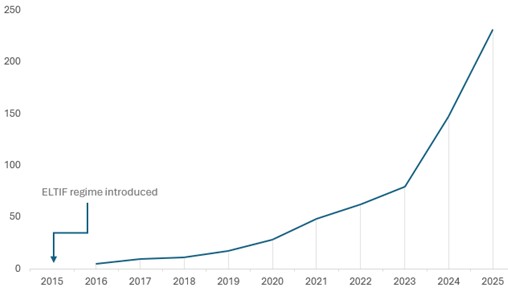
Since implementation, the number of authorised ELTIFs has risen
sharply. According to ESMA data, active vehicles have grown from
just five in 2016 to more than 230 in 2025 (Figure 4), with the
steepest increase following the reform in January 2024
– fund numbers nearly doubling between 2023 and 2024.
Figure 4: Number of ELTIFs launched
Source: European Securities and Markets Authority. Data
correct as of 31 October 2025.
This acceleration reflects growing demand for long-term
private-market exposure and the accessibility introduced under
ELTIF. For private banks and wealth managers, it represents a
structural broadening of opportunity.
The future of fixed income is private, short term, and
real (1)
With inflation patterns diverging across Southern Europe,
investors are refocusing on stability, liquidity, and
diversification within income-generating portfolios. Asset-based
finance is emerging as a complementary component within modern
fixed-income allocations – offering exposure to real-economy
repayments.
For private banks and family offices, this marks an important
evolution in portfolio design. In an environment of shifting
inflation dynamics, true diversification increasingly depends on
assets grounded in measurable cashflows rather than market
cycles.
About Fasanara Capital
Fasanara Capital is an independent London-based asset manager and
fintech platform specialising in alternative credit and
quantitative strategies. Founded in 2011, the firm manages over
$5.5 billion on behalf of institutional and professional
investors globally.
Footnote:
1, The views expressed are of Fasanara Capital Ltd.