


Trust Estate
Financial Parenting – Successful Wealth Transfer Starts Long Before Inheritance

What is called "financial parenting" is a process that needs to take place long before inheritance and/or major liquidity events take effect.
The following article is from Marianna Mamou, head of advice beyond investing, Chief Investment Office Global Wealth Management at UBS Global Wealth Management, part of UBS.
The editors are pleased to share these views; the usual editorial disclaimers apply to views of outside contributors. To comment, email tom.burroughes@wealthbriefing.com and amanda.cheesley@clearviewpublishing.com.
For many people, their relationship with money begins in
childhood. Children learn from what their parents say, the
decisions they observe and the financial responsibilities they
are encouraged to take on. These everyday experiences help shape
their attitudes toward spending, saving and managing
money.
The UBS Financial parenting: Preparing the next generation
for financial wellbeing report explores how parents can
support this learning through conversations, example and
practical experience. For families preparing for wealth
transfer, it also provides a starting point for helping the
next generation understand the responsibilities of managing
inherited wealth.
Financial parenting involves helping children acquire the
knowledge, skills and tools to make financial decisions, and
develop the habits and judgement to use them effectively.
Children can learn by making small, everyday financial decisions,
experiencing the consequences and reflecting on what they would
do differently.
The inheritance conversations families are not
having
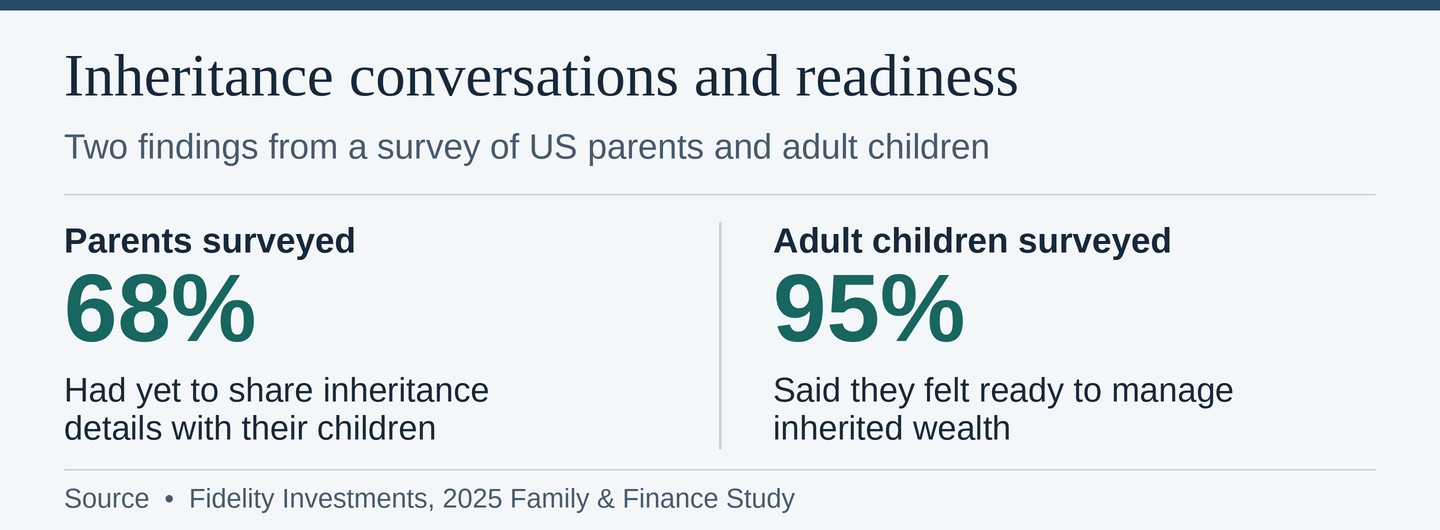
A 2025 Fidelity survey, cited in the UBS report, found
that 68 per cent of parents surveyed had not shared inheritance
details with their children, while 95 per cent of adult children
said they felt ready to manage inherited wealth.
Sharing information about an inheritance is not the same as
preparing children to manage it. Disclosure and preparation are
distinct tasks. Families need to consider both what information
to share and how to help children develop the judgement to manage
inherited wealth responsibly.
Parents may be reluctant to discuss wealth for understandable
reasons. Some worry that disclosing too much information could
undermine motivation, encourage entitlement or create anxiety.
Others may simply be uncertain about when to begin these
conversations or how much information is appropriate to
share.
However, avoiding the subject can carry its own risks. Without an
understanding of the family’s wealth, future heirs may struggle
to grasp the responsibilities that come with it. They may also be
unfamiliar with the decisions and values that shaped it.
Families can begin by discussing the purpose of wealth, the
importance of financial independence and the responsibilities
that come with having resources, before gradually introducing
more detailed information about inheritance arrangements. This
can help make wealth transfer a process of preparation rather
than a single moment of disclosure.
The money messages children inherit
Financial education extends beyond formal discussions about
saving, investing and inheritance. Children’s attitudes
toward money are also shaped by the financial behaviors and
'money messages' they observe throughout their upbringing.
Explicit messages might include guidance on budgeting, saving for
a goal or giving to charitable causes. Implicit messages are
communicated through everyday behavior, such as how parents
approach spending, respond to market volatility or discuss
financial uncertainty.
For example, parents who consistently avoid discussing money may
unintentionally communicate that finances are a private or
uncomfortable subject. Equally, parents who react anxiously to
market movements may reinforce the perception that financial
uncertainty is something to fear.
Research cited in the report suggests that children may pick up
their parents’ attitudes toward investing and risk,
including overconfidence, loss aversion and the illusion of
control.
Importantly, there is no single approach to financial parenting
that will suit every family. What matters is that parents
recognize the messages they may be passing on and consider
whether those messages will support their children's long-term
financial wellbeing. This may involve demonstrating the
importance of financial discipline, even when financial security
is assured, recognizing the trade-offs involved in investment
decisions, and understanding how wealth can create opportunities
to benefit others as well as oneself.
Why parental role models and early conversations
matter
Research by the FINRA Investor Education Foundation and CFA Institute, cited
in the UBS
report, offer a useful comparison of parental
conversations among Gen Z investors and non-investors.
Among those surveyed, 79 per cent of Gen Z investors reported
having parents who discussed investing with them, compared with
46 per cent of Gen Z non-investors.
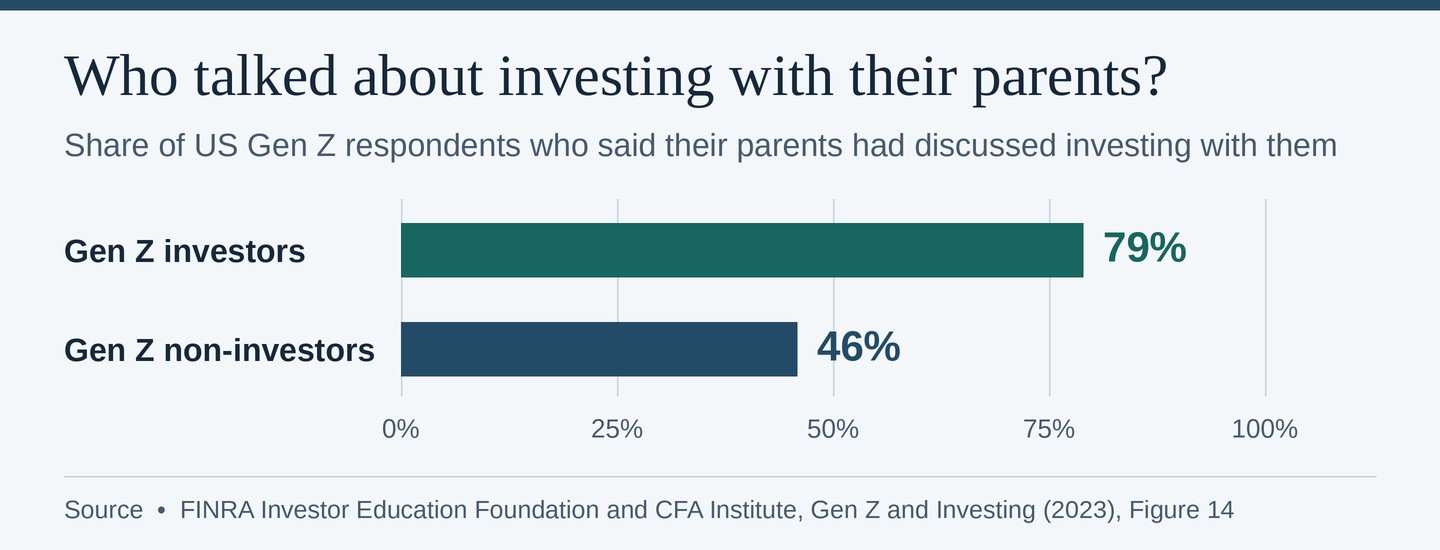
These findings suggest an association between family
conversations and young adults’ participation in investing,
rather than proving that parental engagement encourages children
to invest.
What successful wealth transfer looks like
Ultimately, successful wealth transfer involves more than
ensuring that the appropriate legal and financial structures are
in place. It also means equipping future wealth holders with the
judgement and confidence to make decisions independently.
This is best approached as a gradual process, with financial
responsibilities increasing as children demonstrate readiness
rather than simply reaching a particular age. Readiness can be
seen in the ability to accept limits, explain a trade-off, learn
from a mistake and ask for advice before a consequential
decision.
For younger children, financial education might begin with
distinguishing between needs and wants, setting savings goals and
making small spending decisions. Teenagers can begin exploring
budgeting, investing, diversification and the relationship
between risk and return. As children reach adulthood,
families can introduce more complex responsibilities, such as
participating in family investment discussions, managing defined
budgets or contributing to philanthropic decisions. These
experiences can provide opportunities for developing
financial capability.
Philanthropy can be particularly valuable for encouraging
conversations about family values and the responsibilities that
come with wealth. Similarly, early involvement in family
governance and investment decisions can help future heirs
understand how and why wealth is managed. There is no
universal schedule for these financial conversations. The
appropriate level of disclosure and responsibility will depend on
individual maturity, family circumstances and the complexity of
the wealth involved.
Regardless of when the conversations take place, a successful
wealth transfer should equip the next generation with the
confidence to ask questions, the discipline to consider long-term
consequences and an understanding of how wealth can support both
personal ambitions and wider family values.
As the Great Wealth Transfer gathers pace, families that begin
these conversations early may be in a better position to
prepare the next generation for the responsibilities ahead. After
all, the true measure of successful wealth transfer lies not in
how much the next generation inherits, but in how well prepared
they are to manage it.